


Resisting Misalignment
In our mind, entropy and heat are commonly associated with complete disorder. Heat melts crystals, demagnetizes magnets, and is the enemy of superconductors and quantum computers. Here we present two quantum field theories in which a continuous symmetry stays broken at arbitrarily high temperature. In both, order survives even at infinite temperature. The first, found by Claude Opus 5.5, is a superfluid at all temperatures and a superconductor over an enormous range of temperatures. The second, found by Fable 5, breaks a chiral symmetry similar to the one in the strong nuclear force. This symmetry is believed to have been restored in the hot early universe. But it does not have to be so, as our example demonstrates. These are the very first examples of this kind, with continuous order at any temperature.
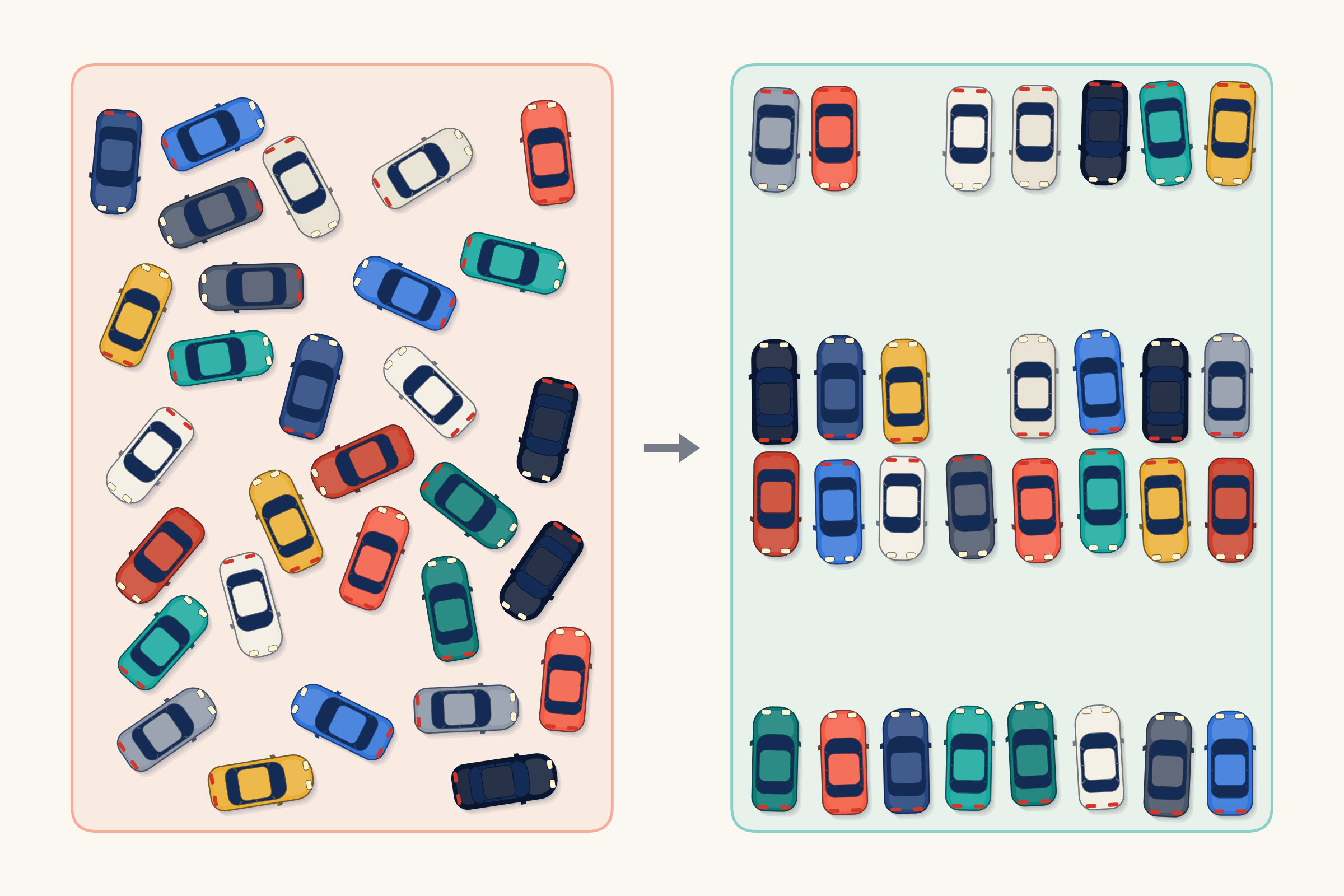
Shake a shallow box filled with nails and an odd thing may happen. The pile that began as a tangle develops order: more and more nails point in roughly the same direction. Parallel nails get in each other’s way less than crossed nails do, so lining up opens room for nails to slide. Lars Onsager made this precise in 1949 for long, thin rods [2]: above a critical density, the aligned arrangement has more entropy than the random one. The rods give up their freedom to rotate, and gain much more freedom to move around. This seems bizarre, but it is correct. Entropy is commonly described as a measure of untidiness. More precisely, it counts the microscopic arrangements available to a system, and sometimes an ordered pattern creates more of them [6, 7]. The same geometry is at work in any unmarked parking lot on the day of a festival: once enough cars arrive, they end up in neat rows (Figure 1).
(a) Crowded cars
(b) Rods and nails

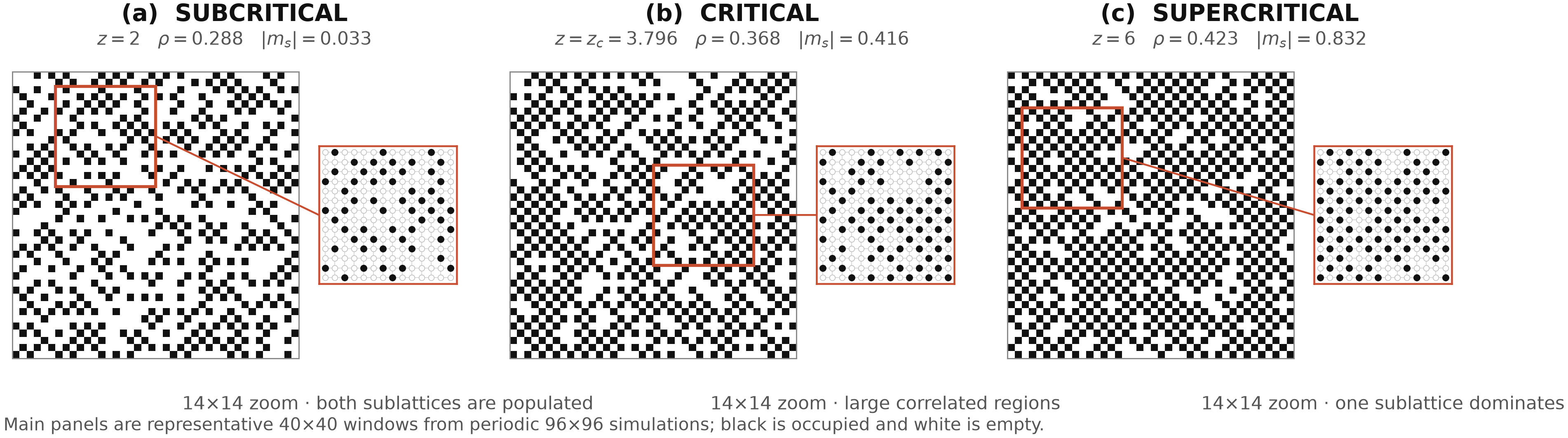
Another beautiful example is the “hard-square” lattice gas: particles on a square grid, with the single rule that no two of them may sit on neighboring sites. Baxter, Enting and Tsang [4] found in 1980 that once about 37% of the sites are filled, the particles spontaneously crowd onto one of the two checkerboard sublattices (Figure 2). The initial rules treat both checkerboards alike, but the dense gas picks one spontaneously. Choosing a sublattice looks like a loss of entropy, but on the chosen sublattice there is much more room.
These examples rely on constraints: nails cannot overlap, and hard squares cannot be neighbors. These examples are purely “combinatorial” – they have no temperature and no energy.
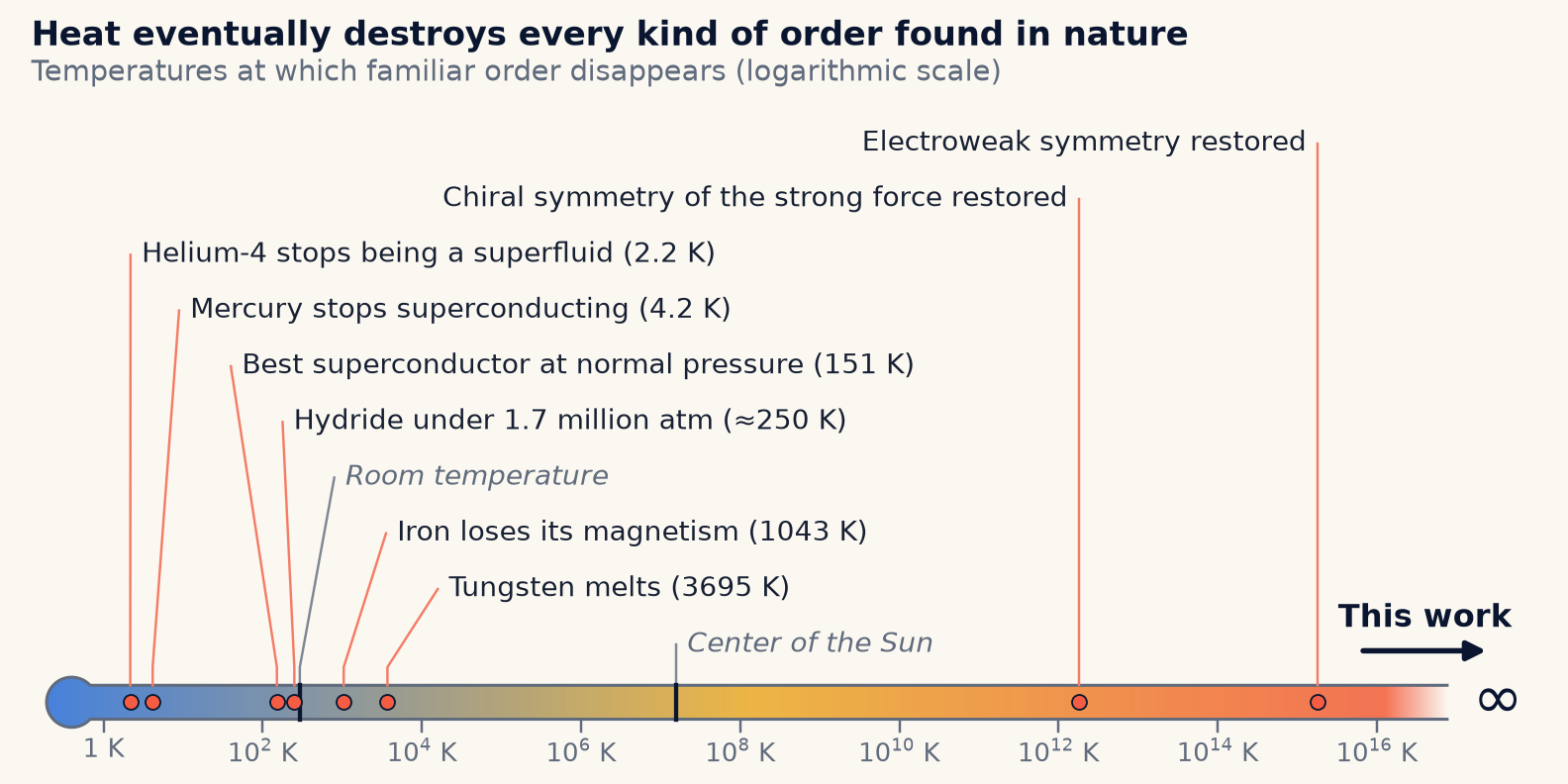
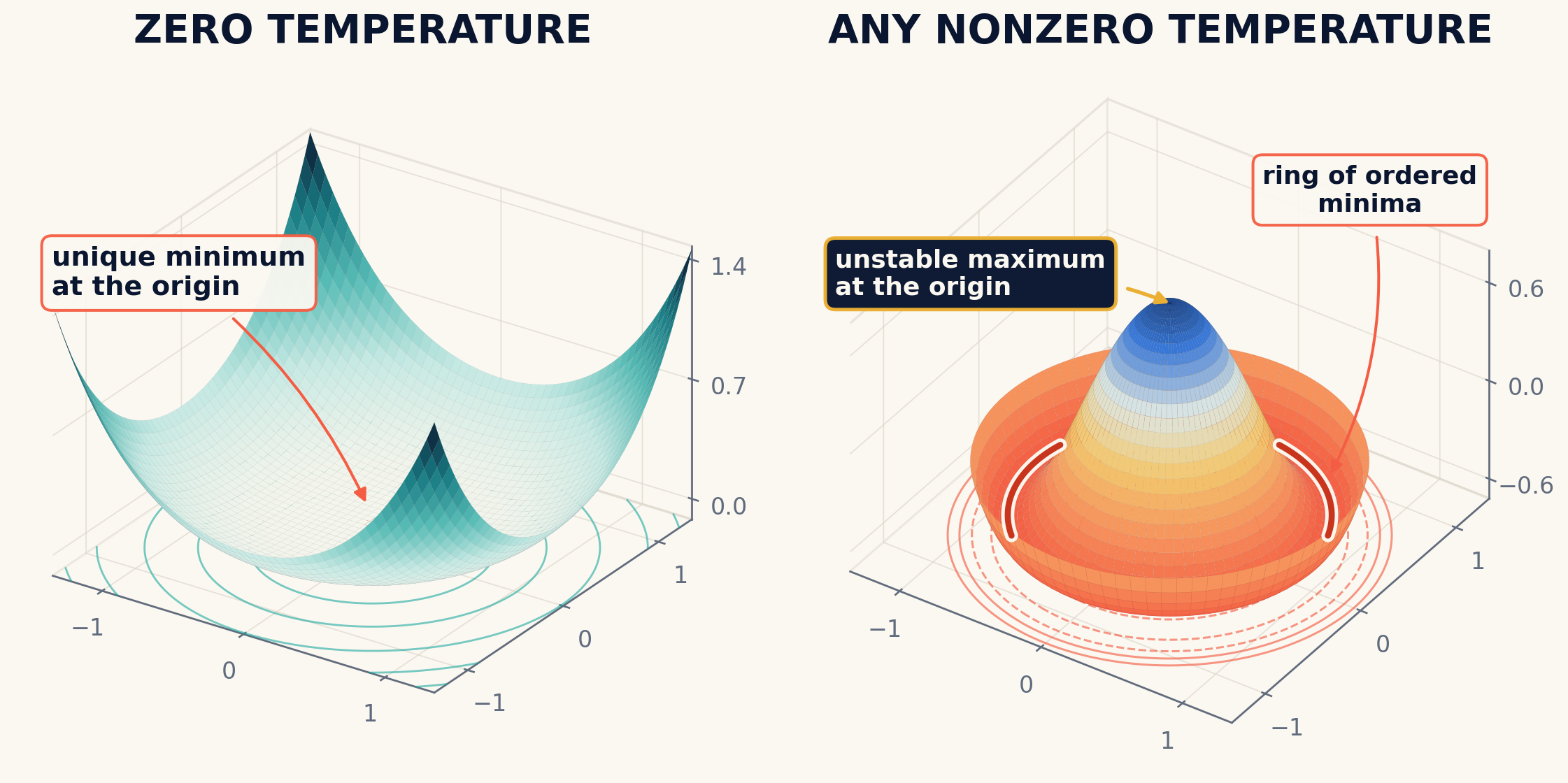
In physical systems, a system at temperature \(T\) settles into the state that minimizes the free energy \(F=E-TS\), where \(E\) is the energy and \(S\) the entropy. Low energy favors economical configurations, high entropy favors abundance of possible states, and as the temperature grows the entropy wins. We therefore expect complete disorder at high temperature: a magnet loses its alignment, a crystal melts, a superconductor turns into an ordinary metal (Figure 3). The examples above hint that this expectation can fail, because maximizing entropy is not the same as maximizing disorder.
Nature even provides a famous case in which heating freezes a liquid. Below about 0.3 kelvin, helium-3 held at a pressure of about thirty atmospheres solidifies when it is warmed. Pomeranchuk predicted this in 1950 [9]: in the crystal the nuclear spins are almost free to point any way they like, while in the liquid they are locked into a degenerate Fermi sea, so that the crystal, of all things, has the larger entropy. Held just below its melting pressure, helium-3 is a superfluid at the lowest temperatures, below about 2.5 thousandths of a kelvin, and it turns solid when it is heated; the solid melts again only near one kelvin. A crystal thus sits at higher temperatures than a superfluid. Since squeezing the mixture of liquid and solid cools it, this became a refrigerator, and it was in such a “Pomeranchuk cell” that Osheroff, Richardson and Lee discovered the superfluid in 1972 [10, 11, 13, 14]. Rochelle salt similarly is ferroelectric only between −18 and 24 degrees Celsius [15]. In these materials the inverted order is confined to a window of temperatures, and enough heat eventually wins. But should it always?
Order at Infinite Temperature
For a large class of systems, order at very high temperature is in fact forbidden. The classic Dobrushin uniqueness theorem [17] and the related high-temperature expansions show that if each site of a lattice has finitely many states, and the interactions are short-ranged, then sufficiently high temperature leaves a single, disordered equilibrium state.
A recent construction exploits a loophole: the theorem explicitly requires finitely many states per site, which is not necessarily physical. In the Arithmetic Ising Model [19], each site can hold any integer number of bosons, \(n_x=0,1,2,\ldots\); each boson costs an energy \(\mu\), and bosons on neighboring sites repel each other with strength \(U\), so that \(E=\mu\sum\limits_x n_x+U\sum\limits_{\langle x,y\rangle}n_xn_y\). At zero temperature, in a ground state, every site is empty. At high temperature the bosons pile up on one sublattice and leave the other nearly empty. The checkerboard has less freedom about which sites are busy, but vastly more about how many bosons sit on the busy ones. Mean-field theory and simulations indicate that this happens at arbitrarily high temperature once \(2 U>\mu\) (Figure 4), and for closely related models it has been argued rigorously [20].
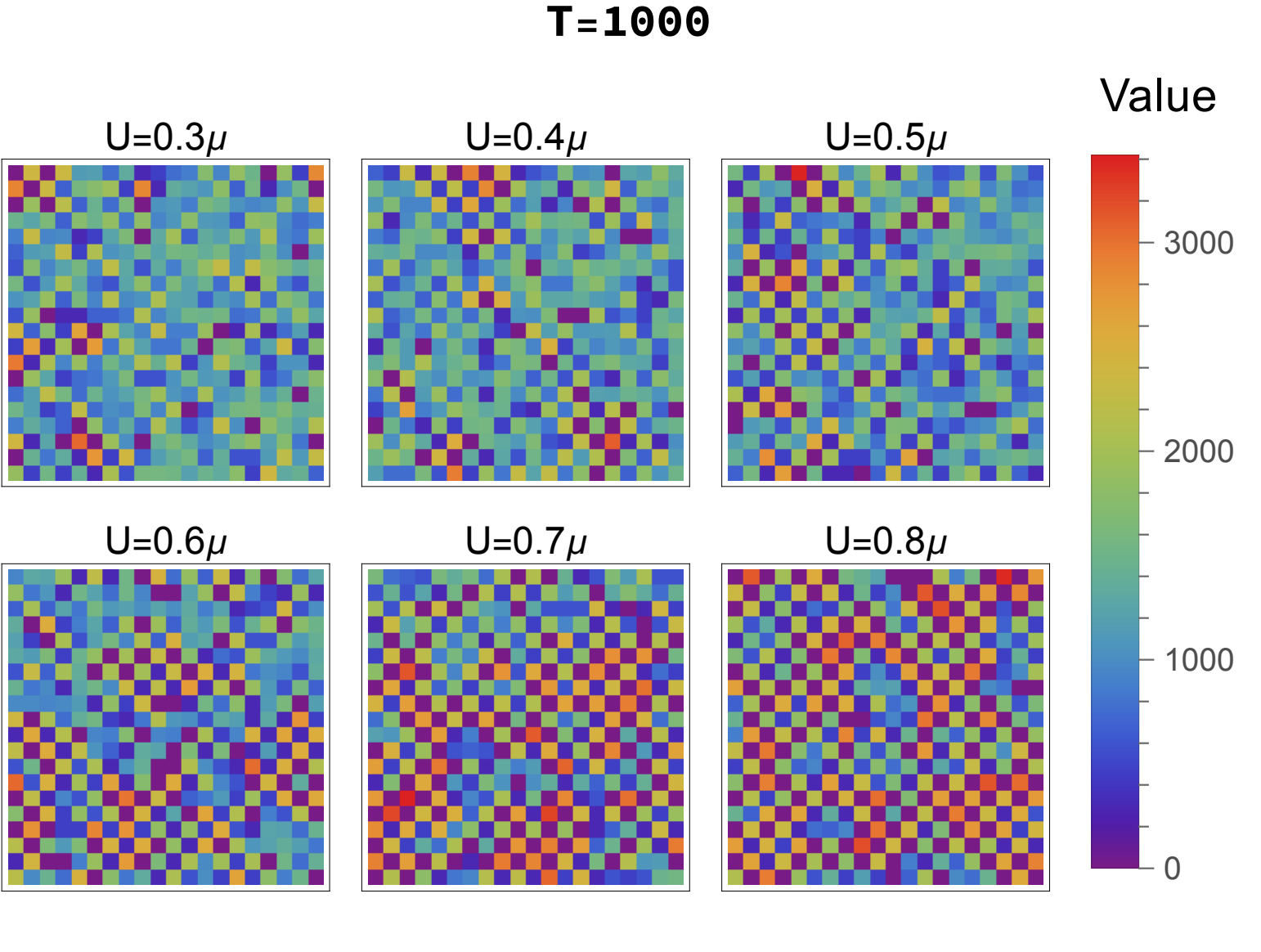
This mechanism, in which the order of one set of degrees of freedom lets another set fluctuate more strongly, is called entropic order [18]. Lattice models built on it realize solids, magnets, superfluids and topological order that survive to arbitrarily high temperature [18, 19, 21]. Since thermal fluctuations are the nemesis of superconductors and quantum computers alike, this is quite remarkable.
Heat in Quantum Field Theory
Quantum field theory describes elementary particles and the early universe. A field has infinitely many degrees of freedom in any region of space, so quantum field theory evades Dobrushin’s theorem automatically. However, it has its own high-temperature lore called symmetry restoration [22–25]: at high temperatures quantum fields usually obtain a positive “thermal mass”, which restores the symmetry. The standard history of the universe is this story run in reverse. As the universe cooled, the electroweak symmetry was broken when the universe was about \(10^{-11}\) seconds old [29], and the chiral symmetry of the strong force when it was about \(10^{-5}\) seconds old [30, 31].
Weinberg [25] already noticed in 1974 that restoration is not a theorem; he pointed to Rochelle salt as a precedent. With several fields, an attractive interaction between them can make one of the thermal masses negative, and heat then destabilizes the symmetric state instead of protecting it (Figure 5). The idea was soon put to work in cosmology: a symmetry that is never restored can keep CP violated in the hot universe [32, 33], spare it the magnetic monopoles and domain walls that a phase transition would leave behind [34, 35, 37–40], and, in recent proposals, keep the electroweak symmetry broken far above the weak scale [48–53]. But two worries accompanied it: the models were not ultraviolet complete, so they break down at some high temperature [57], and the effect came from a delicate competition that higher-order corrections might destroy. Later analyses and lattice simulations settled the second worry in favor of the effect [54–56, 58–61]. But the first worry remained, and no ultraviolet complete models, which would allow one to check whether order can survive to infinite temperature, were previously known. See [62, 63] for a related discussion.
Conformal Field Theories (CFTs) potentially remove the first worry. A CFT has no built-in length or energy scale; it looks the same at every magnification. At temperature \(T\) the only scale is \(T\) itself, so a CFT that is ordered at one temperature is ordered at every temperature.
Thermal order in CFTs was first found in simplified settings: a non-integer number of dimensions [64, 65, 71], non-local interactions [69, 70], or infinitely many fields [64–68]. In recent years, local theories with finitely many fields in two space dimensions were found to break a discrete symmetry at all temperatures [72–76]; see Charlie Wood’s Quanta Magazine feature [1]. On the other hand, a continuous symmetry, that rotates the direction of a compass needle or the phase of a quantum wave, is more fragile: in two space dimensions, even small thermal ripples destroy continuous order (the Mermin–Wagner theorem [78–80]). In three space dimensions, as in our world, they need not. This led to the question:
We found two such theories. To our knowledge, they are the first examples of their kind.
Connection to the No-Hair Theorem
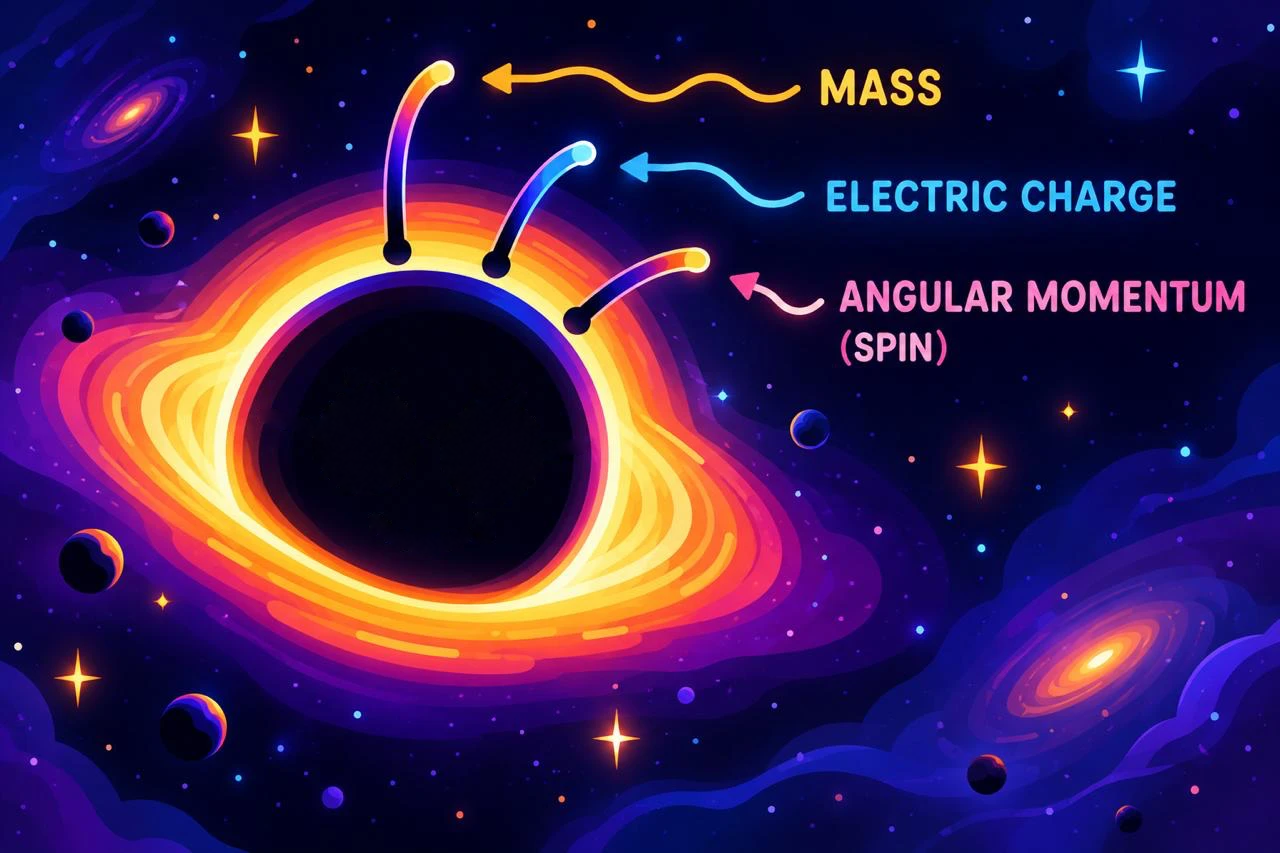
The question also has a gravitational avatar. From the outside, a stationary black hole is described only by its mass, electric charge and angular momentum (Figure 6). An ordered field around it would be “hair”, which no-hair theorems [81–84] forbid in many situations. Through holography, certain CFTs are equivalent to theories of gravity in anti-de Sitter space, and their hot state is described by a black hole [85, 86]. Such black holes do grow hair when they are cold enough, which is how holographic superconductors work [87, 88]; the question is whether the hair can survive the heat. Order at all temperatures then corresponds to a black hole that keeps its hair however hot it is. Holographic attempts have so far produced only hair that is unstable or metastable [89–91]. It remains an open question to find if there are black holes in string theory with robust hair at all temperatures.
A Superfluid at Every Temperature
The simplest continuous symmetry rotates a phase. In a superfluid, a macroscopic number of particles share a single quantum state with a common phase. Which phase is chosen is arbitrary, but once chosen it is shared across the whole sample, like a stadium crowd clapping in unison. This breaks a symmetry called \(U(1)\), with dramatic consequences: the fluid flows without friction, it can rotate only through quantized vortices, and it carries a massless ripple of the phase, the Goldstone boson. Heat scrambles the phase; liquid helium-4 is a superfluid only below 2.17 kelvin [8].
Our first theory, found by Claude Opus 5.5, builds on a construction of Chaudhuri, Choi and Rabinovici [67]. It has two sectors. Each contains two color forces, copies of the strong nuclear force with many colors instead of three, and so many flavors of quarks that the strength of the forces settles to a small, constant value at all distances. Such Banks–Zaks theories [92, 93] are CFTs whose properties can be computed reliably. Each sector also contains a scalar field \(\Phi\) that feels both of its color forces. The small sector, with \(N_2\) colors, is the one that orders; the large sector, with \(N_1\gg N_2\) colors, is an entropy reservoir. The two sectors interact only through a weak, attractive coupling between their scalar fields \(\Phi_{1,2}\).
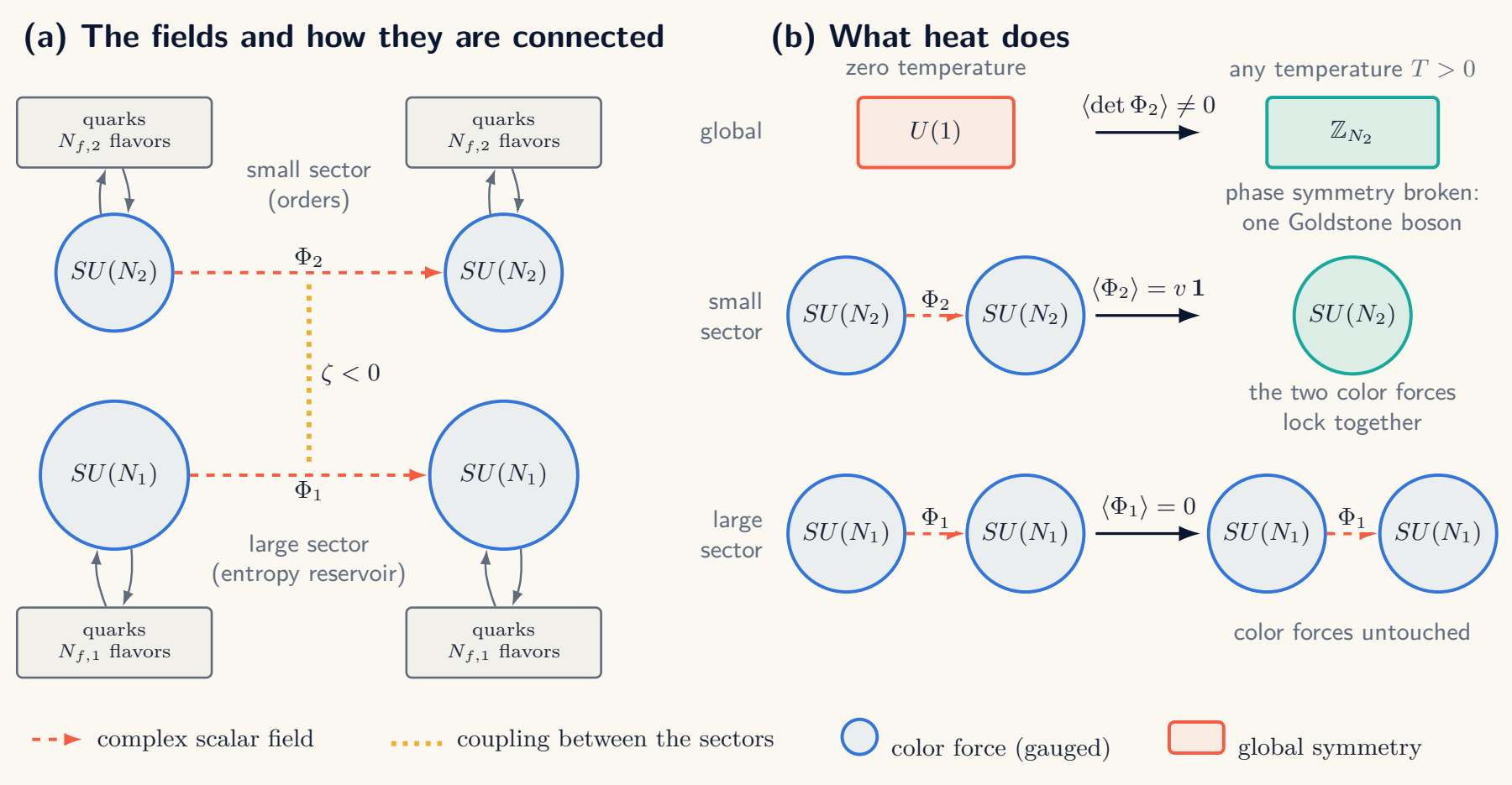
At zero temperature the vacuum is unique and symmetric. At nonzero temperatures the field \(\Phi_2\) of the small sector condenses, and its phase becomes the phase of a superfluid. Heat favors this sacrifice of entropy because of the large sector, which acts as a reservoir that increases the entropy. Through the attractive coupling, the condensate makes each of the roughly \(2N_1^2\) components of \(\Phi_1\) slightly lighter, and lighter particles are easier to excite, so they carry more entropy. Each mode barely notices, but there are so many of them that their combined gain outweighs the entropy lost by the small sector, whose modes (of order \(N_2^2\) of them) become heavier. For the gain to win, the large sector needs at least about 27 times as many scalar components as the small one.
Chaudhuri, Choi and Rabinovici found this behavior in the limit of infinitely many colors. The new example keeps it with finitely many colors, which is important for the construction to be complete. It is one member of an infinite family of theories, with \(N_2=n\) and \(N_1=n^3\) colors, in which all couplings shrink like \(1/n\), so that for large \(n\) every step is under control. The symmetry breaking can be diagnosed using the determinant of \(\Phi_2\) (a “baryon” made of \(N_2\) scalars), which is colorless and whose phase serves as the Goldstone boson of a relativistic superfluid, at every temperature.
The superfluid can also become a superconductor, which is a superfluid made of charged particles, if we couple its phase to the photon, giving \(\Phi_2\) an electric charge. The condensate then gives the photon a mass that grows with the temperature, and magnetic fields are expelled at every temperature at which the condensate exists and below the Landau pole of the photon. Therefore this theory can also serve as a model of a superconductor in a large range of temperatures. A related toy model, a charged scalar coupled to a photon and to many neutral scalars, has previously appeared [18].
Heat-Resistant Chiral Symmetry
Our second theory, found by Fable 5, is modeled on the strong nuclear force and does not have a previous analog in the literature, to our knowledge. In quantum chromodynamics (QCD), each light quark comes in a left-handed and a right-handed version. If the quarks were massless, the strong force would allow the three light left-handed quarks to be rotated into each other independently of the right-handed ones: this is the chiral symmetry \(SU(3)_L\times SU(3)_R\). In the vacuum, quark–antiquark pairs condense and lock left and right together, breaking the symmetry to \(SU(3)_V\); the eight light mesons are its Goldstone bosons. Above about 155 MeV, the condensate melts [30, 31]. The universe was this hot during its first ten microseconds or so, and we strongly believe that the chiral symmetry was restored then.
But it does not have to be so. The new theory (Figure 8) has two color forces, \(SU(N)\) and \(SU(M)\) with \(N=24k\) and \(M=48k\) colors, together with enough additional quarks that both forces settle at a weakly coupled Banks-Zaks fixed point. The quarks \(q\) and \(\tilde q\) carry the chiral symmetry. A scalar field \(H\), a \(3\times3\) matrix that feels no color force, plays the role of the quark condensate. A second scalar, \(X\), feels both color forces.
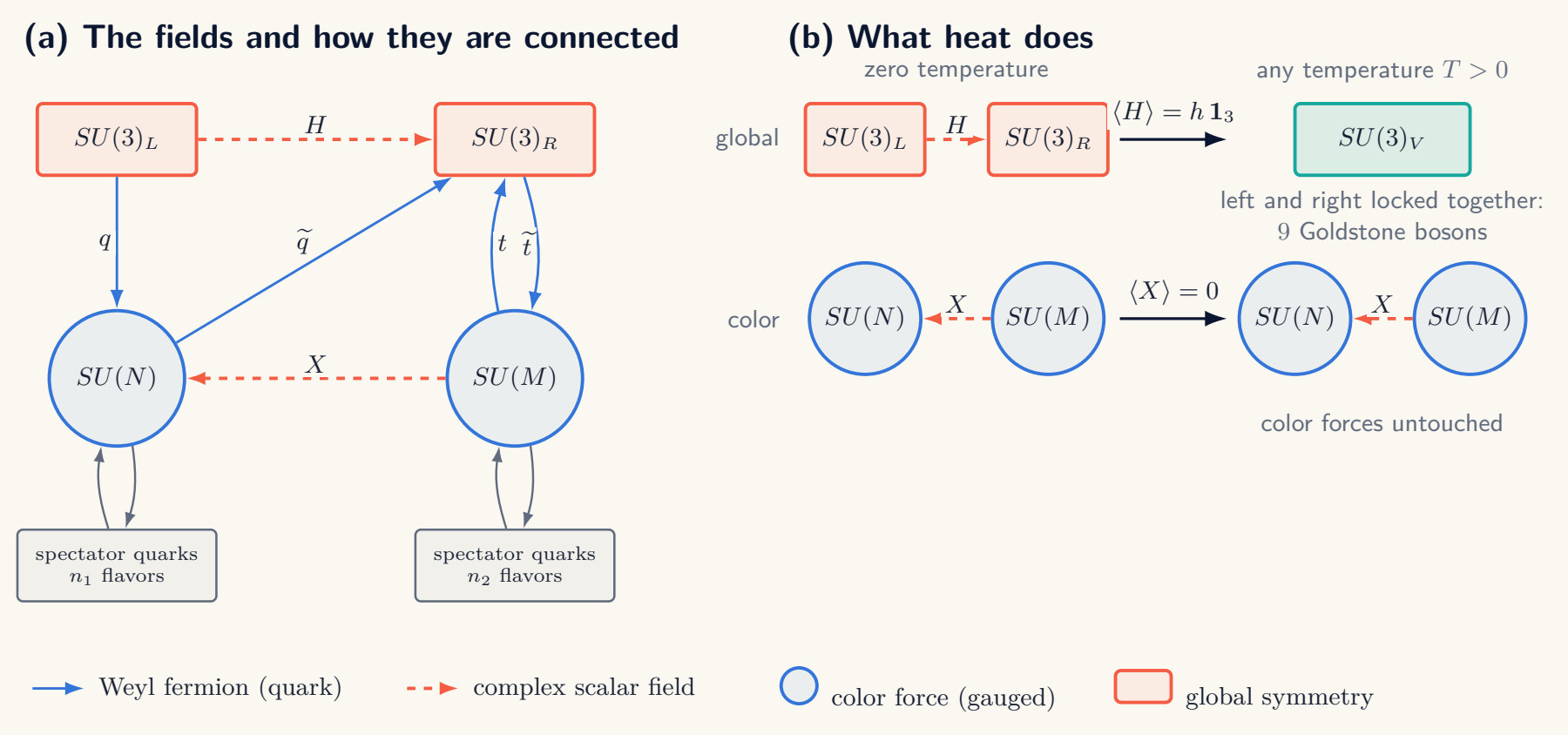
At zero temperature nothing is broken: the vacuum is unique and symmetric. Heat the theory, and the sea of thermally excited \(X\) particles pulls on \(H\) through a weak attractive coupling, amplified by their enormous number. \(H\) condenses into a multiple of the identity matrix and locks left and right together, exactly as in the QCD vacuum. Eight Goldstone bosons appear, together with a ninth from an additional phase symmetry. The condensate is created by heat alone, and since the theory is conformal, it is present at every nonzero temperature. As in the superfluid, the order is entropic, with \(X\) as the entropy reservoir. Unlike there, both color forces are left intact, and the order parameter \(H\) is itself colorless.
Hot gauge theories have a notorious difficulty: at the longest distances their magnetic forces become strongly coupled, beyond the reach of perturbative calculations [95, 96]. Here this does not matter, because all colored matter drops out before that happens [97, 98], and the remaining magnetic forces carry no chiral charge; their effect on the free energy is too small, by a factor of order \(1/k\), to undo the order. It is also shown that each further order of perturbation theory is suppressed by \(1/k\).
If a symmetry is never restored, the universe never passes through the corresponding phase transition, and the relics that such a transition can leave behind, such as domain walls, cosmic strings and magnetic monopoles [42–45, 47], are not produced. Symmetry non-restoration has long been proposed as a way to avoid such relics [34, 35, 37, 38, 41]. Our theory shows that a QCD-like chiral symmetry can stay broken at all temperatures in a consistent, ultraviolet-complete quantum field theory.
Outlook
We saw at the beginning that shaking helps the system find more room – it helps the system to find a high entropy state. Our theories replace nails and cars with quantum fields, which are defined at any temperature. We find, surprisingly, that also in systems of quantum fields the most spacious state is the ordered one. We showed examples of superfluid order, and a broken chiral symmetry. Many questions remain. How small can such theories be? What do the vortices and the flow of a superfluid that never melts look like? Can holographic black holes keep this kind of hair? And can an entropy reservoir protect a superconductor in a real material, that can be engineered in the lab? Are there examples of quantum field theories with thermal order which are not multi-critical?
References
- C. Wood, “Heat Destroys All Order. Except for in This One Special Case,” Quanta Magazine (2025). Link
References 2–98, the technical and historical literature, are collected by subject in Appendix B.
Image credits. Figure 4 is reproduced from Huang et al. under CC BY 4.0. The illustration in Figure 6 is inspired by the visual style of the animation studio Kurzgesagt – In a Nutshell.
Appendix A: The Theories in Formulas
The details below are sufficient to reproduce all the results in the main text. A more extensive presentation will appear shortly.
The superfluid theory. The gauge group is \([SU(N_1)_{\rm a}\times SU(N_1)_{\rm b}]\times [SU(N_2)_{\rm a}\times SU(N_2)_{\rm b}]\). Each sector \(i=1,2\) has \(N_{f,i}\) Dirac fermions in the fundamental of each of its two factors and a complex scalar \(\Phi_i\) in the bifundamental; a \(\mathbb Z_2\) symmetry sets the two gauge couplings of a sector equal to \(g_i\), and flavor symmetries forbid Yukawa couplings. Besides the gauge-invariant kinetic terms, the Lagrangian contains the potential \[ V=\sum_{i=1,2}\Big[\tilde h_i\,\tr\big(\Phi_i^\dagger\Phi_i\big)^2 +\tilde f_i\,\big(\tr\Phi_i^\dagger\Phi_i\big)^2\Big] +2\tilde\zeta\,\tr\Phi_1^\dagger\Phi_1\,\tr\Phi_2^\dagger\Phi_2\,. \] With the ’t Hooft couplings \(\lambda_i=g_i^2N_i/16\pi^2\), \(h_i=N_i\tilde h_i/16\pi^2\), \(f_i=N_i^2\tilde f_i/16\pi^2\), \(\zeta=N_1N_2\tilde\zeta/16\pi^2\), and \(x_i=N_{f,i}/N_i\), \(\epsilon_i=1/N_i^2\), \(\epsilon_{12}=1/(N_1N_2)\), the beta functions [94] are \begin{align*} \beta_{\lambda_i}&=-\tfrac{21-4x_i}{3}\,\lambda_i^2 +\Big[\tfrac{26x_i-54}{3}-(4+2x_i)\,\epsilon_i\Big]\lambda_i^3\,,\\ \beta_{h_i}&=8h_i^2-12(1-\epsilon_i)\lambda_ih_i+\big(\tfrac32-12\epsilon_i\big)\lambda_i^2 +24\epsilon_if_ih_i\,,\\ \beta_{f_i}&=4(1+4\epsilon_i)f_i^2+16f_ih_i-12(1-\epsilon_i)\lambda_if_i+12h_i^2 +\big(\tfrac92+6\epsilon_i\big)\lambda_i^2+4\zeta^2\,,\\ \beta_\zeta&=\zeta\big[4(1+\epsilon_1)f_1+4(1+\epsilon_2)f_2+8h_1+8h_2 -6(1-\epsilon_1)\lambda_1-6(1-\epsilon_2)\lambda_2+8\epsilon_{12}\zeta\big]\,, \end{align*} where the gauge couplings are given to two loops and the quartic couplings to one loop. The gauge couplings sit at the Banks–Zaks values [92, 93] \(\lambda_i^*\simeq(21N_i-4N_{f,i})/(82.5\,N_i)\). When \(N_i\to\infty\), the quartic fixed points form a circle, \(\tfrac12(f_1+f_2)=\tfrac{\sqrt6}{2}\lambda\) and \(\tfrac12(f_1-f_2)+i\zeta=\widehat R\lambda e^{i\theta}\) with \(\widehat R\approx0.564\); at finite \(N\) it is lifted at order \(1/N^2\) to isolated fixed points. The thermal masses enter as \(V+16\pi^2T^2(c_1\tr\Phi_1^\dagger\Phi_1+c_2\tr\Phi_2^\dagger\Phi_2)\) with, on the circle and for \(r=N_2/N_1\), \[ \frac{c_2}{\lambda}=\frac12+\frac{\widehat R}{6}\Big(\frac{\sin\theta}{r}-\cos\theta\Big)\,, \] which is negative on an arc with \(\zeta<0\) when \(r<0.191\). The family \(\mathcal T_n\), with \(n\equiv1\pmod 4\), has \[ N_1=n^3\,,\qquad N_{f,1}=\tfrac14\big(21n^3-n^2+12\big)\,,\qquad N_2=n\,,\qquad N_{f,2}=\tfrac14\big(21n-1\big)\,, \] and couplings \(\lambda^*\simeq2/(165n)\); as \(n\to\infty\) its ordered fixed point approaches \(h_i/\lambda\to0.138\), \(f_1/\lambda\to1.174\), \(f_2/\lambda\to1.276\), \(\zeta/\lambda\to-0.562\). The thermal minimum is \[ \Phi_1=0\,,\qquad \Phi_2=v\,U\,,\quad U\in U(N_2)\,,\qquad v^2=-\frac{c_2N_2}{2(h_2+f_2)}\,T^2\,, \] which breaks \(U(1)_{\Phi_2}\to\mathbb Z_{N_2}\) with \(\langle\det\Phi_2\rangle\neq0\), and lowers the free energy by \(0.00297\,n^5T^4\,[1-1.817/\sqrt n+\dots]\). Coupling \(U(1)_{\Phi_2}\) to a photon with coupling \(e\) gives the Meissner mass \(m_{\rm M}^2=2e^2N_2v^2\), i.e. \(m_{\rm M}/T\simeq0.257\,e\,n^2\). The coupling runs as \(de/d\log\mu=N_2^2e^3/48\pi^2\); for \(e(\mu_0)=\hat e/n^2\) the Landau pole is at \(\mu_0\exp(24\pi^2n^2/\hat e^{\,2})\).
The chiral theory. The gauge group is \(SU(N)\times SU(M)\) with \(N=24k\), \(M=48k\) and flavor symmetry \(SU(3)_L \times SU(3)_R\), with \(F=3\) flavors. The matter consists of Weyl fermions \(q\in(\mathbf N,\mathbf 1;\mathbf 3,\mathbf 1)\), \(\tilde q\in(\overline{\mathbf N},\mathbf 1;\mathbf 1,\overline{\mathbf 3})\), \(t\in(\mathbf 1,\mathbf M;\mathbf 1,\overline{\mathbf 3})\), \(\tilde t\in(\mathbf 1,\overline{\mathbf M};\mathbf 1,\mathbf 3)\) under \(SU(N)\times SU(M)\times SU(3)_L\times SU(3)_R\), complex scalars \(H\in(\mathbf 1,\mathbf 1;\mathbf 3,\overline{\mathbf 3})\) and \(X\in(\mathbf N,\mathbf M;\mathbf 1,\mathbf 1)\), and \(n_1=120k-5\), \(n_2=258k-9\) spectator quarks in the fundamental representations of \(SU(N)\) and \(SU(M)\) correspondingly. The interactions are \begin{align*} \mathcal L_Y&=-y\,H^\dagger_{ba}\,q_{ia}\tilde q^{\,i}_{b}-y_2\,X^{im}\,\tilde q_{i,a}\tilde t_{m,a} +\text{h.c.}\,,\\ V&=u\,\tr\big[(H^\dagger H)^2\big]+v\,\big[\tr H^\dagger H\big]^2+k_A\big[\tr X^\dagger X\big]^2 +k_B\,\tr\big[(X^\dagger X)^2\big]+w\,\tr(H^\dagger H)\,\tr(X^\dagger X)\,. \end{align*} With \(16\pi^2\beta_g\equiv\dot g\), the one-loop beta functions of the Yukawa couplings and of the couplings that involve \(H\) are \begin{align*} \dot y/y&=-3\big(N-\tfrac1N\big)g_1^2+(F+N)\,y^2+\tfrac M2\,y_2^2\,,\qquad \dot u=8Fu^2+24uv+4Nuy^2-2Ny^4\,,\\ \dot y_2/y_2&=-\tfrac32\big(N-\tfrac1N\big)g_1^2-\tfrac32\big(M-\tfrac1M\big)g_2^2 +\tfrac F2\,y^2+\tfrac{2F+M+N}{2}\,y_2^2\,,\\ \dot v&=12u^2+16Fuv+4(4+F^2)v^2+MNw^2+4Nvy^2\,,\qquad \dot w=4w^2+Bw-4y^2y_2^2\,, \end{align*} with \(B=-3(N-\tfrac1N)g_1^2-3(M-\tfrac1M)g_2^2+2Ny^2+2Fy_2^2+4(1+MN)k_A+4(M+N)k_B+8Fu+4(1+F^2)v\); the equations for \(k_A\), \(k_B\) and the two-loop gauge equations are in the papers. For \(\delta=1/k\), the fixed point has the large-\(k\) form \[ \begin{aligned} g_1^2&\simeq A\delta^2, & g_2^2&\simeq\tfrac{76}{77}A\delta^2, & y^2&\simeq\tfrac{2}{77}A\delta^2, & y_2^2&\simeq\tfrac{229}{77}A\delta^2, & u&\simeq\tfrac1{77}A\delta^2,\\ k_B&\simeq0.136\,A\delta^2, & v&\simeq-0.0058\,A\delta^3, & k_A&\simeq0.017\,A\delta^3, & w&\simeq-0.0033\,A\delta^3, && \end{aligned} \] with \(A=16\pi^2\cdot77/563760\approx0.0216\). The potential is bounded from below, and the vacuum \(H=X=0\) is unique. The leading thermal mass of \(H\) is \[ \frac{m_H^2}{T^2}=\frac F3u+\frac{1+F^2}{6}v+\frac{MN}{12}w+\frac N{12}y^2=-0.00569\,\delta+O(\delta^2)\,, \] and including the leading screening correction from \(X\), \(m_H^2/T^2=-0.00569\,\delta+0.00356\,\delta^{3/2}+O(\delta^2|\log\delta|)\). The thermal minimum is \(H=h\,\mathbf 1_3\) with \(h^2/T^2\simeq10.15\,k\) and \(X=0\); it lowers the free energy by about \(0.087\,T^4\) and breaks \(SU(3)_L\times SU(3)_R\to SU(3)_V\) and an additional \(U(1)\), giving nine Goldstone bosons, while both gauge groups remain unbroken.
Appendix B: A Guide to the Literature
The list below is certainly incomplete.
Order from entropy
Hard rods, hard spheres and hard squares order because order leaves them more room. Frenkel’s two essays are the best places to start.
- L. Onsager, “The effects of shape on the interaction of colloidal particles,” Ann. N.Y. Acad. Sci. 51, 627 (1949). DOI
- B. J. Alder and T. E. Wainwright, “Phase transition for a hard sphere system,” J. Chem. Phys. 27, 1208 (1957). DOI
- R. J. Baxter, I. G. Enting and S. K. Tsang, “Hard-square lattice gas,” J. Stat. Phys. 22, 465 (1980). DOI
- J. Villain, R. Bidaux, J.-P. Carton and R. Conte, “Order as an effect of disorder,” J. Phys. France 41, 1263 (1980). DOI
- D. Frenkel, “Entropy-driven phase transitions,” Physica A 263, 26 (1999). DOI
- D. Frenkel, “Order through entropy,” Nature Materials 14, 9 (2015). DOI
Helium, and other materials that order when heated
The Pomeranchuk effect and the discovery of superfluid helium-3 in a Pomeranchuk cell; Rochelle salt, the first ferroelectric, is ordered only between two Curie points.
- P. Kapitza, “Viscosity of liquid helium below the \(\lambda\)-point,” Nature 141, 74 (1938); J. F. Allen and A. D. Misener, “Flow of liquid helium II,” Nature 141, 75 (1938). DOI
- I. Pomeranchuk, “On the theory of liquid He\(^3\),” Zh. Eksp. Teor. Fiz. 20, 919 (1950).
- D. D. Osheroff, R. C. Richardson and D. M. Lee, “Evidence for a new phase of solid He\(^3\),” Phys. Rev. Lett. 28, 885 (1972). DOI
- D. D. Osheroff, W. J. Gully, R. C. Richardson and D. M. Lee, “New magnetic phenomena in liquid He\(^3\) below 3 mK,” Phys. Rev. Lett. 29, 920 (1972). DOI
- A. J. Leggett, “Interpretation of recent results on He\(^3\) below 3 mK: a new liquid phase?” Phys. Rev. Lett. 29, 1227 (1972). DOI
- D. M. Lee, “The extraordinary phases of liquid \(^3\)He,” Rev. Mod. Phys. 69, 645 (1997). DOI
- R. C. Richardson, “The Pomeranchuk effect,” Rev. Mod. Phys. 69, 683 (1997). DOI
- J. Valasek, “Piezo-electric and allied phenomena in Rochelle salt,” Phys. Rev. 17, 475 (1921). DOI
- A. L. Greer, “Too hot to melt,” Nature 404, 134 (2000). DOI
High-temperature uniqueness and entropic order
Dobrushin’s theorem, and the lattice models that evade it by giving each site infinitely many states.
- R. L. Dobrushin, “The problem of uniqueness of a Gibbsian random field and the problem of phase transitions,” Funct. Anal. Appl. 2, 302 (1968). DOI
- Y. Han, X. Huang, Z. Komargodski, A. Lucas and F. K. Popov, “Entropic order,” Nature Commun. 17, 87 (2026). arXiv:2503.22789
- X. Huang, Z. Komargodski, A. Lucas, F. K. Popov and T. Sulejmanpasic, “Minimal models of entropic order” (2025). arXiv:2512.07980
- E. Andriolo, M. Nguyen, E. Richards and T. Sulejmanpasic, “Proof of entropic order in generalized Ising models” (2026). arXiv:2604.09768
- P.-S. Hsin and R. Kobayashi, “Exploring entropic orders: high temperature continuous symmetry breaking, chiral topological states and local commuting projector models” (2026). arXiv:2604.18694
Symmetry restoration in hot field theory and in the early universe
The examples where heat restores symmetries, the thermal effective potential, and the lattice results on how the electroweak and chiral symmetries of the Standard Model are in fact restored.
- D. A. Kirzhnits, “Weinberg model in the hot universe,” JETP Lett. 15, 529 (1972).
- D. A. Kirzhnits and A. D. Linde, “Macroscopic consequences of the Weinberg model,” Phys. Lett. B 42, 471 (1972). DOI
- L. Dolan and R. Jackiw, “Symmetry behavior at finite temperature,” Phys. Rev. D 9, 3320 (1974). DOI
- S. Weinberg, “Gauge and global symmetries at high temperature,” Phys. Rev. D 9, 3357 (1974). DOI
- A. D. Linde, “Phase transitions in gauge theories and cosmology,” Rep. Prog. Phys. 42, 389 (1979). DOI
- J. I. Kapusta and C. Gale, Finite-Temperature Field Theory: Principles and Applications (Cambridge University Press, 2006).
- M. Laine and A. Vuorinen, Basics of Thermal Field Theory, Lect. Notes Phys. 925 (Springer, 2016). arXiv:1701.01554
- K. Kajantie, M. Laine, K. Rummukainen and M. Shaposhnikov, “Is there a hot electroweak phase transition at \(m_H\gtrsim m_W\)?” Phys. Rev. Lett. 77, 2887 (1996). arXiv:hep-ph/9605288
- Y. Aoki, G. Endrődi, Z. Fodor, S. D. Katz and K. K. Szabó, “The order of the quantum chromodynamics transition predicted by the standard model of particle physics,” Nature 443, 675 (2006). arXiv:hep-lat/0611014
- A. Bazavov et al. (HotQCD Collaboration), “Chiral crossover in QCD at zero and non-zero chemical potentials,” Phys. Lett. B 795, 15 (2019). arXiv:1812.08235
Symmetry non-restoration and cosmology
Weinberg’s loophole at work: CP violation and broken symmetries in the hot universe, the monopole and domain-wall problems, and, more recently, an electroweak symmetry that stays broken far above the weak scale. Bajc’s review summarizes the earlier literature.
- R. N. Mohapatra and G. Senjanović, “Soft CP-invariance violation at high temperature,” Phys. Rev. Lett. 42, 1651 (1979). DOI
- R. N. Mohapatra and G. Senjanović, “Broken symmetries at high temperature,” Phys. Rev. D 20, 3390 (1979). DOI
- P. Langacker and S.-Y. Pi, “Magnetic monopoles in grand unified theories,” Phys. Rev. Lett. 45, 1 (1980). DOI
- P. Salomonson, B.-S. Skagerstam and A. Stern, “On the primordial monopole problem in grand unified theories,” Phys. Lett. B 151, 243 (1985). DOI
- Y. Fujimoto and S. Sakakibara, “On symmetry non-restoration at high temperature,” Phys. Lett. B 151, 260 (1985). DOI
- G. Dvali and G. Senjanović, “Is there a domain wall problem?” Phys. Rev. Lett. 74, 5178 (1995). arXiv:hep-ph/9501387
- G. Dvali, A. Melfo and G. Senjanović, “Is there a monopole problem?” Phys. Rev. Lett. 75, 4559 (1995). arXiv:hep-ph/9507230
- G. Dvali, A. Melfo and G. Senjanović, “Nonrestoration of spontaneously broken P and CP at high temperature,” Phys. Rev. D 54, 7857 (1996). arXiv:hep-ph/9601376
- G. Bimonte and G. Lozano, “Can symmetry non-restoration solve the monopole problem?” Nucl. Phys. B 460, 155 (1996). arXiv:hep-th/9509060
- B. Bajc, “High temperature symmetry nonrestoration,” in Proc. COSMO-99 (World Scientific, 2000). arXiv:hep-ph/0002187
- Ya. B. Zeldovich, I. Yu. Kobzarev and L. B. Okun, “Cosmological consequences of a spontaneous breakdown of a discrete symmetry,” Zh. Eksp. Teor. Fiz. 67, 3 (1974) [Sov. Phys. JETP 40, 1 (1974)].
- T. W. B. Kibble, “Topology of cosmic domains and strings,” J. Phys. A 9, 1387 (1976). DOI
- Ya. B. Zeldovich and M. Yu. Khlopov, “On the concentration of relic magnetic monopoles in the universe,” Phys. Lett. B 79, 239 (1978). DOI
- J. Preskill, “Cosmological production of superheavy magnetic monopoles,” Phys. Rev. Lett. 43, 1365 (1979). DOI
- A. H. Guth, “Inflationary universe: a possible solution to the horizon and flatness problems,” Phys. Rev. D 23, 347 (1981). DOI
- A. Vilenkin and E. P. S. Shellard, Cosmic Strings and Other Topological Defects (Cambridge University Press, 1994).
- P. Meade and H. Ramani, “Unrestored electroweak symmetry,” Phys. Rev. Lett. 122, 041802 (2019). arXiv:1807.07578
- I. Baldes and G. Servant, “High scale electroweak phase transition: baryogenesis & symmetry non-restoration,” JHEP 10, 053 (2018). arXiv:1807.08770
- A. Glioti, R. Rattazzi and L. Vecchi, “Electroweak baryogenesis above the electroweak scale,” JHEP 04, 027 (2019). arXiv:1811.11740
- O. Matsedonskyi and G. Servant, “High-temperature electroweak symmetry non-restoration from new fermions and implications for baryogenesis,” JHEP 09, 012 (2020). arXiv:2002.05174
- M. Carena, C. Krause, Z. Liu and Y. Wang, “New approach to electroweak symmetry nonrestoration,” Phys. Rev. D 104, 055016 (2021). arXiv:2104.00638
- P. Agrawal and M. Nee, “Avoided deconfinement in Randall–Sundrum models,” JHEP 10, 105 (2021). arXiv:2103.05646
Is non-restoration robust?
Higher orders, the renormalization group and lattice simulations confirm that the effect is real, but in the original scalar models it does not continue all the way to infinite temperature.
- G. Bimonte and G. Lozano, “On symmetry non-restoration at high temperature,” Phys. Lett. B 366, 248 (1996). arXiv:hep-th/9507079
- T. G. Roos, “Wilson renormalization group study of inverse symmetry breaking,” Phys. Rev. D 54, 2944 (1996). arXiv:hep-th/9511073
- M. Pietroni, N. Rius and N. Tetradis, “Inverse symmetry breaking and the exact renormalization group,” Phys. Lett. B 397, 119 (1997). arXiv:hep-ph/9612205
- J. Orloff, “The UV price for symmetry non-restoration,” Phys. Lett. B 403, 309 (1997). arXiv:hep-ph/9611398
- M. B. Gavela, O. Pène, N. Rius and S. Vargas-Castrillón, “The fading of symmetry non-restoration at finite temperature,” Phys. Rev. D 59, 025008 (1999). arXiv:hep-ph/9801244
- M. B. Pinto and R. O. Ramos, “A nonperturbative study of inverse symmetry breaking at high temperatures,” Phys. Rev. D 61, 125016 (2000). arXiv:hep-ph/9912273
- K. Jansen and M. Laine, “Inverse symmetry breaking with 4D lattice simulations,” Phys. Lett. B 435, 166 (1998). arXiv:hep-lat/9805024
- G. Bimonte, D. Iñiguez, A. Tarancón and C. L. Ullod, “Inverse symmetry breaking on the lattice: an accurate MC study,” Nucl. Phys. B 559, 103 (1999). arXiv:hep-lat/9903027
- B. Bajc, A. Lugo and F. Sannino, “Asymptotically free and safe fate of symmetry nonrestoration,” Phys. Rev. D 103, 096014 (2021). arXiv:2012.08428
- B. Bajc, G. Muco, F. Sannino and S. Wagner, “Infinite heat order in 3+1 dimensions,” Phys. Rev. D 113, 125029 (2026). arXiv:2604.01184
Thermal order in conformal field theories
From the first examples, in non-integer dimensions and at infinite \(N\), through non-local models, to local theories with finitely many fields in 2+1 dimensions. The last entry is the general framework for CFTs at nonzero temperature.
- N. Chai, S. Chaudhuri, C. Choi, Z. Komargodski, E. Rabinovici and M. Smolkin, “Symmetry breaking at all temperatures,” Phys. Rev. Lett. 125, 131603 (2020). DOI
- N. Chai, S. Chaudhuri, C. Choi, Z. Komargodski, E. Rabinovici and M. Smolkin, “Thermal order in conformal theories,” Phys. Rev. D 102, 065014 (2020). arXiv:2005.03676
- N. Chai, E. Rabinovici, R. Sinha and M. Smolkin, “The bi-conical vector model at \(1/N\),” JHEP 05, 192 (2021). arXiv:2011.06003
- S. Chaudhuri, C. Choi and E. Rabinovici, “Thermal order in large \(N\) conformal gauge theories,” JHEP 04, 203 (2021). arXiv:2011.13981
- S. Chaudhuri and E. Rabinovici, “Symmetry breaking at high temperatures in large \(N\) gauge theories,” JHEP 08, 148 (2021). arXiv:2106.11323
- N. Chai, A. Dymarsky and M. Smolkin, “Model of persistent breaking of discrete symmetry,” Phys. Rev. Lett. 128, 011601 (2022). arXiv:2106.09723
- N. Chai, A. Dymarsky, M. Goykhman, R. Sinha and M. Smolkin, “A model of persistent breaking of continuous symmetry,” SciPost Phys. 12, 181 (2022). arXiv:2111.02474
- P. Liendo, J. Rong and H. Zhang, “Spontaneous breaking of finite group symmetries at all temperatures,” SciPost Phys. 14, 168 (2023). arXiv:2205.13964
- B. Hawashin, J. Rong and M. M. Scherer, “Ultraviolet-complete local field theory of persistent symmetry breaking in 2+1 dimensions,” Phys. Rev. Lett. 134, 041602 (2025). arXiv:2409.10606
- Z. Komargodski and F. K. Popov, “Temperature-resistant order in 2+1 dimensions,” Phys. Rev. Lett. 135, 091602 (2025). arXiv:2412.09459
- B. Hawashin, M. M. Scherer, M. Smolkin and L. Yung, “Spontaneous spacetime parity breaking without thermal restoration,” Phys. Rev. D 114, 065005 (2026). arXiv:2507.19890
- M. Smolkin and L. Yung, “Thermal order in the biconical model” (2026). arXiv:2608.02720
- M. Smolkin and L. Yung, “Persistent spontaneous time-reversal breaking” (2026). arXiv:2609.16162
- L. Iliesiu, M. Koloğlu, R. Mahajan, E. Perlmutter and D. Simmons-Duffin, “The conformal bootstrap at finite temperature,” JHEP 10, 070 (2018). arXiv:1802.10266
No continuous order in two dimensions
- N. D. Mermin and H. Wagner, “Absence of ferromagnetism or antiferromagnetism in one- or two-dimensional isotropic Heisenberg models,” Phys. Rev. Lett. 17, 1133 (1966). DOI
- P. C. Hohenberg, “Existence of long-range order in one and two dimensions,” Phys. Rev. 158, 383 (1967). DOI
- S. Coleman, “There are no Goldstone bosons in two dimensions,” Commun. Math. Phys. 31, 259 (1973). DOI
Black holes, hair and holography
No-hair theorems, the holographic dictionary in which a hot CFT is a black hole, the hair that black holes in anti-de Sitter space do grow at low temperature, and the search for hair that survives at all temperatures.
- R. Ruffini and J. A. Wheeler, “Introducing the black hole,” Physics Today 24(1), 30 (1971). DOI
- W. Israel, “Event horizons in static vacuum space-times,” Phys. Rev. 164, 1776 (1967). DOI
- B. Carter, “Axisymmetric black hole has only two degrees of freedom,” Phys. Rev. Lett. 26, 331 (1971). DOI
- J. D. Bekenstein, “Novel ‘no-scalar-hair’ theorem for black holes,” Phys. Rev. D 51, R6608 (1995). DOI
- J. Maldacena, “The large \(N\) limit of superconformal field theories and supergravity,” Adv. Theor. Math. Phys. 2, 231 (1998). arXiv:hep-th/9711200
- E. Witten, “Anti-de Sitter space, thermal phase transition, and confinement in gauge theories,” Adv. Theor. Math. Phys. 2, 505 (1998). arXiv:hep-th/9803131
- S. S. Gubser, “Breaking an Abelian gauge symmetry near a black hole horizon,” Phys. Rev. D 78, 065034 (2008). arXiv:0801.2977
- S. A. Hartnoll, C. P. Herzog and G. T. Horowitz, “Building a holographic superconductor,” Phys. Rev. Lett. 101, 031601 (2008). arXiv:0803.3295
- A. Buchel, “Thermal order in holographic CFTs and no-hair theorem violation in black branes,” Nucl. Phys. B 967, 115425 (2021). arXiv:2005.07833
- A. Buchel, “Fate of the conformal order,” Phys. Rev. D 103, 026008 (2021). arXiv:2011.11509
- A. Buchel, “Holographic conformal order with higher derivatives,” Nucl. Phys. B 1004, 116578 (2024). arXiv:2312.15764
Tools: conformal gauge theories and hot gauge fields
Banks–Zaks fixed points, the beta functions of a general gauge theory, the infrared problem of hot gauge theories, and dimensional reduction.
- W. E. Caswell, “Asymptotic behavior of non-Abelian gauge theories to two-loop order,” Phys. Rev. Lett. 33, 244 (1974). DOI
- T. Banks and A. Zaks, “On the phase structure of vector-like gauge theories with massless fermions,” Nucl. Phys. B 196, 189 (1982). DOI
- M. E. Machacek and M. T. Vaughn, “Two-loop renormalization group equations in a general quantum field theory,” Nucl. Phys. B 222, 83 (1983); 236, 221 (1984); 249, 70 (1985). DOI
- A. D. Linde, “Infrared problem in the thermodynamics of the Yang–Mills gas,” Phys. Lett. B 96, 289 (1980). DOI
- D. J. Gross, R. D. Pisarski and L. G. Yaffe, “QCD and instantons at finite temperature,” Rev. Mod. Phys. 53, 43 (1981). DOI
- T. Appelquist and R. D. Pisarski, “High-temperature Yang–Mills theories and three-dimensional quantum chromodynamics,” Phys. Rev. D 23, 2305 (1981). DOI
- K. Kajantie, M. Laine, K. Rummukainen and M. Shaposhnikov, “Generic rules for high temperature dimensional reduction and their application to the standard model,” Nucl. Phys. B 458, 90 (1996). arXiv:hep-ph/9508379