

Our Research / Inside the proton
The textbook proton is three quarks sitting quietly together. The real one is a seething swarm of quarks, antiquarks and gluons, all moving and spinning, and most of its mass comes not from the quarks themselves but from the energy of the force that binds them. Zhongbo Kang's group builds the theory that turns particle-collision data into three-dimensional pictures of that swarm, showing how quarks move sideways and how their motion is tied to the proton's spin.
Three quarks? Not quite
Every atom you are made of has protons at its heart, and the protons are held together by the strong force, described by the theory called quantum chromodynamics (QCD). In the simplest picture a proton is two "up" quarks and one "down" quark, glued together by force carriers called gluons.
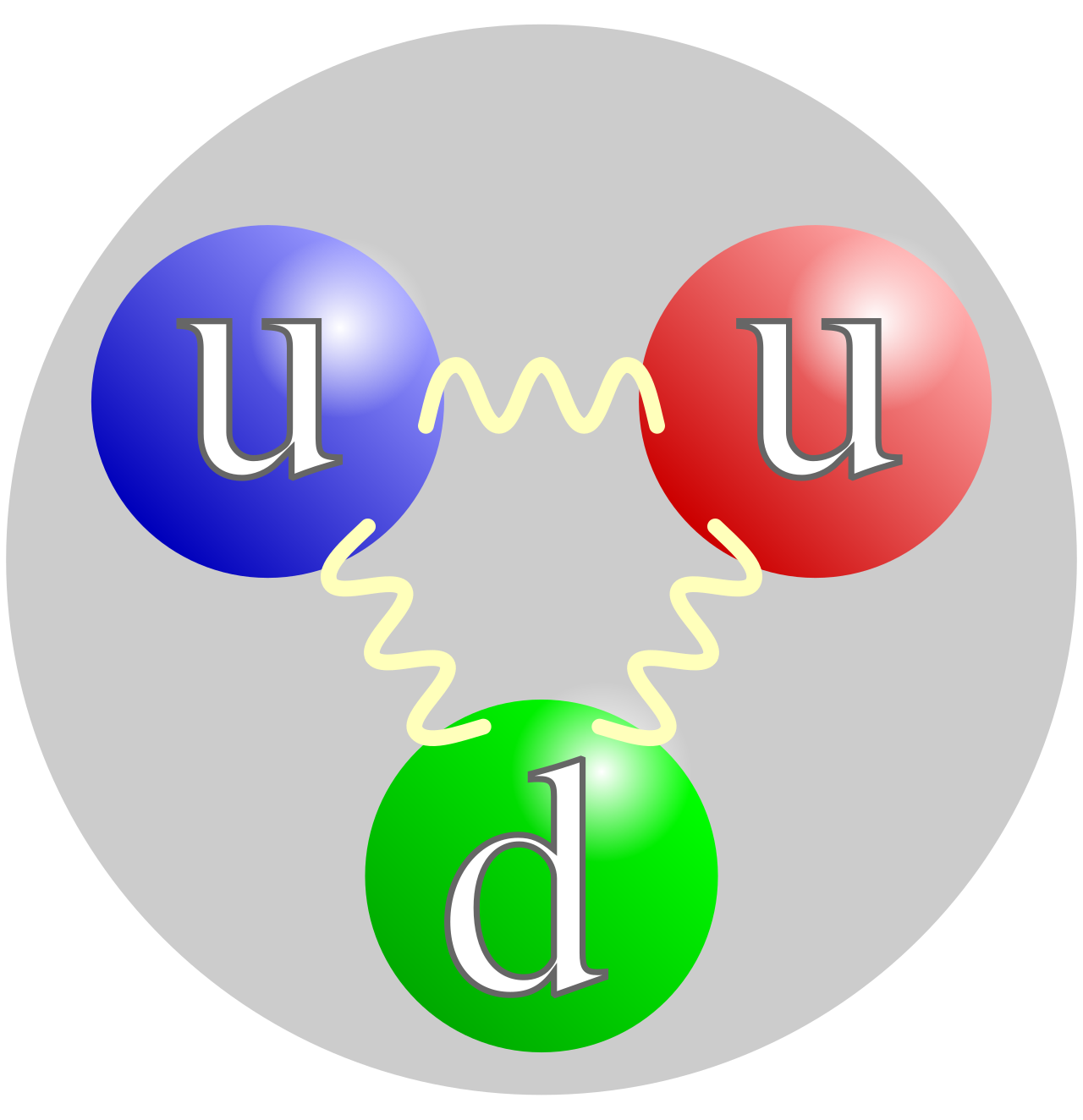
Look closer, with higher-energy collisions, and the picture changes completely: gluons multiply, and short-lived quark-antiquark pairs form a "sea". Gluons and the binding energy they carry account for nearly 99% of the proton's mass. And in 1987 experiments found that the quarks' spins supply only a small part of the proton's spin; today's estimate is about a third. Where does the rest come from? Answering that requires knowing not just what is inside the proton, but how it moves.
A 3D map of quark motion
The classic way to probe a proton is to fire an electron at it and catch what flies out. For decades the results were summarized as one-dimensional maps: how much of the proton's forward momentum a quark carries. Kang's work is part of a field-wide push to go further, to a three-dimensional picture that also records how quarks drift sideways. The tools for this are called TMDs (transverse-momentum-dependent distributions, a fancy name for "maps of sideways motion").
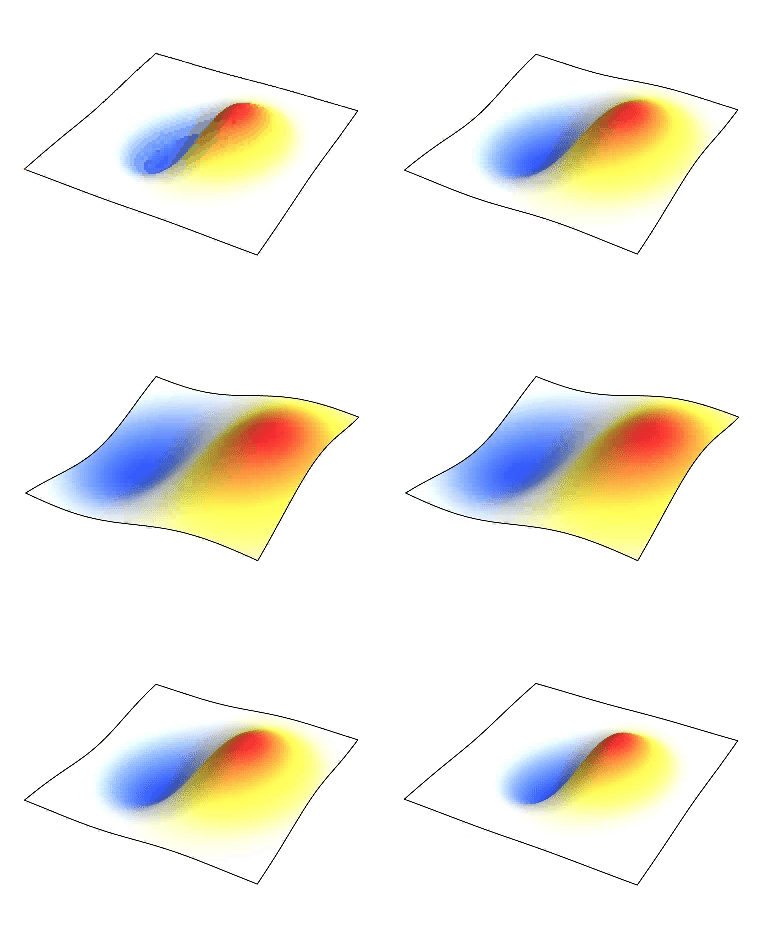
One TMD is especially striking. If the proton spins sideways, quarks inside it prefer to drift to one side rather than the other, a lopsidedness called the Sivers effect. It is a direct fingerprint of quark motion linked to spin. The hard part is that a measured asymmetry depends on the collision energy, so data from different experiments cannot be compared naively. In 2014 Kang and collaborators built this energy dependence ("QCD evolution") into a fit of Sivers measurements from HERMES, COMPASS and Jefferson Lab, and used it to make predictions for Drell-Yan and W-boson experiments, which bear on a sharp test of QCD: the Sivers effect should flip sign between electron-proton collisions and Drell-Yan production.
In 2015 the team extracted the "transversity" of up and down quarks, a measure of how quark spins line up inside a sideways-spinning proton, by combining electron-positron data from Belle and BaBar with proton data from HERMES, COMPASS and Jefferson Lab. A 2020 analysis pushed the Sivers fit to higher theoretical precision and added Drell-Yan and RHIC data, and a 2021 study extended the 3D picture to quarks inside whole nuclei.
Jets as cameras
Quarks are never seen alone. Struck hard, they turn into sprays of particles called jets. Kang, with Felix Ringer and Ivan Vitev, developed in 2016 a precise effective-theory description of how a quark or gluon becomes a jet of a given size, making jets a quantitative tool rather than a messy byproduct. More recently the group has turned to energy correlators, which track how energy is shared out at different angles inside a jet. In 2025 they showed that such correlators can carry a clean spin signal from a polarized proton, offering a new route to transversity at RHIC and the future Electron-Ion Collider, and built a framework connecting these correlators to how quarks turn into pairs of hadrons.
Building a new microscope
The Electron-Ion Collider (EIC), now being built at Brookhaven National Laboratory, will be the first collider of polarized electrons with polarized protons, designed to take exactly these 3D snapshots and to look for a predicted state of saturated gluons. Kang is one of the hundreds of authors of the 2021 EIC Yellow Report, which set out the machine's science requirements and detector concepts. His group also works on gluon saturation, showing for example how two theoretical descriptions of particles scattering inside dense nuclei agree where both apply.
New tools: AI and quantum computers
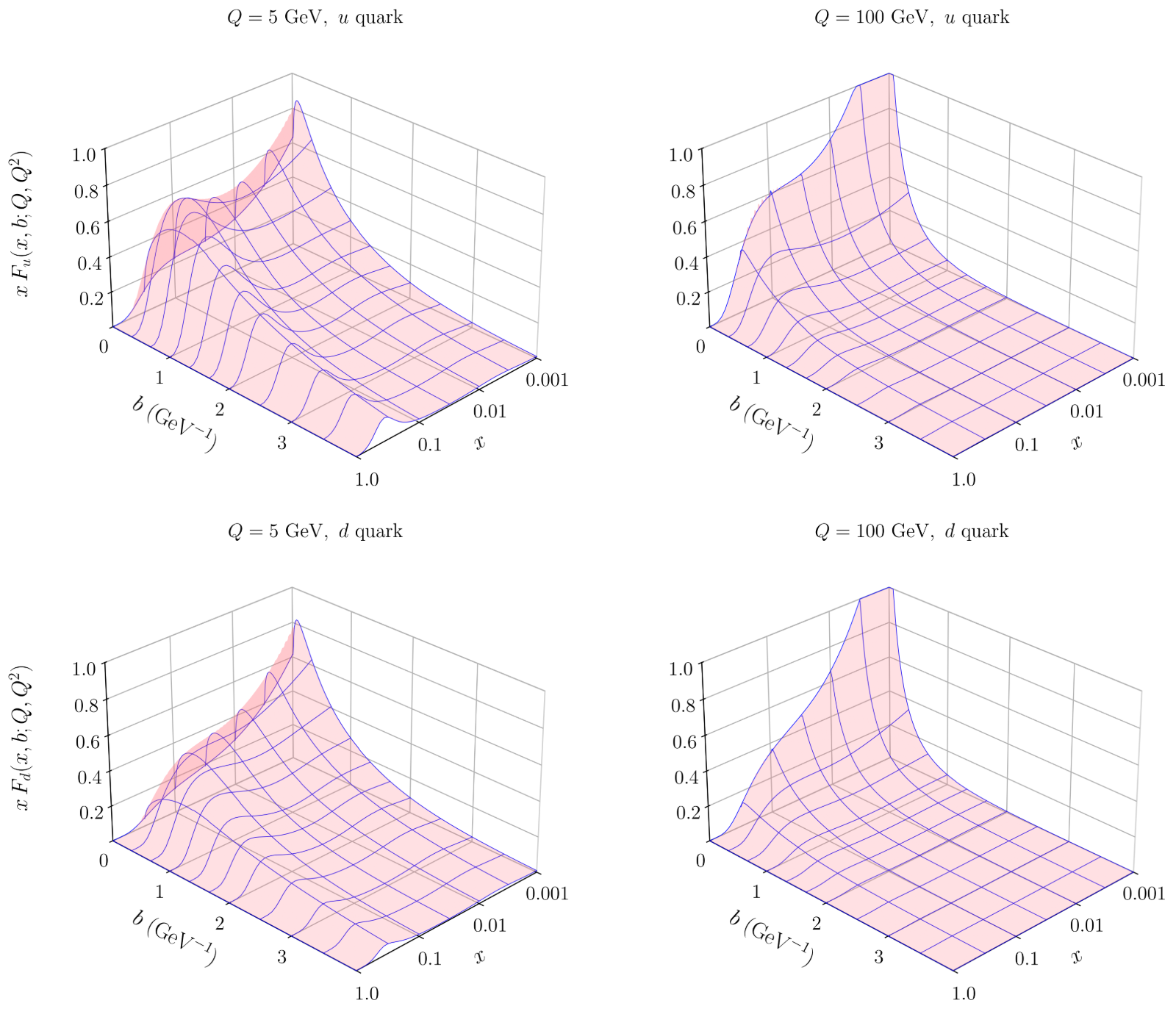
Turning hundreds of data points into a 3D map is a giant inference problem. In 2026 the group (with graduate students Luke Sellers and Congyue Zhang and undergraduate Curtis Zhou) used an AI-driven search for the best mathematical forms, a machine-learning emulator as a fast stand-in for slow calculations, and full Bayesian statistics to extract quark TMDs from Drell-Yan data worldwide. The group is also exploring quantum computers and tensor networks, testing on simplified one-dimensional models how parton distributions could one day be computed from first principles.
In 2026 Kang was named a Fellow of the American Physical Society for contributions to understanding the nucleon's spin and momentum structure and for pioneering jet substructure as a tool for 3D imaging of hadrons. He is also a recipient of the Humboldt Foundation's Friedrich Wilhelm Bessel Research Award.
Key papers
- QCD evolution of the Sivers asymmetryM. G. Echevarria, A. Idilbi, Z.-B. Kang, I. Vitev · (2014). arXiv:1401.5078
- Extraction of quark transversity distribution and Collins fragmentation functions with QCD evolutionZ.-B. Kang, A. Prokudin, P. Sun, F. Yuan · (2015). arXiv:1505.05589
- The semi-inclusive jet function in SCET and small radius resummation for inclusive jet productionZ.-B. Kang, F. Ringer, I. Vitev · (2016). arXiv:1606.06732
- Global analysis of the Sivers functions at NLO+NNLL in QCDM. G. Echevarria, Z.-B. Kang, J. Terry · (2020). arXiv:2009.10710
- Three-dimensional imaging in nucleiM. Alrashed, D. Anderle, Z.-B. Kang, J. Terry, H. Xing · (2021). arXiv:2107.12401
- Science requirements and detector concepts for the Electron-Ion Collider: EIC Yellow ReportEIC User Group (incl. Z.-B. Kang) · (2021). arXiv:2103.05419
- Accessing nucleon transversity with one-point energy correlatorsM.-S. Gao, Z.-B. Kang, W. Li, D. Y. Shao · (2025). arXiv:2509.15809
- AI-assisted modeling and Bayesian inference of unpolarized quark transverse momentum distributions from Drell-Yan dataZ.-B. Kang, L. Sellers, C. Zhang, C. Zhou · (2026). arXiv:2604.14133
More questions we are asking
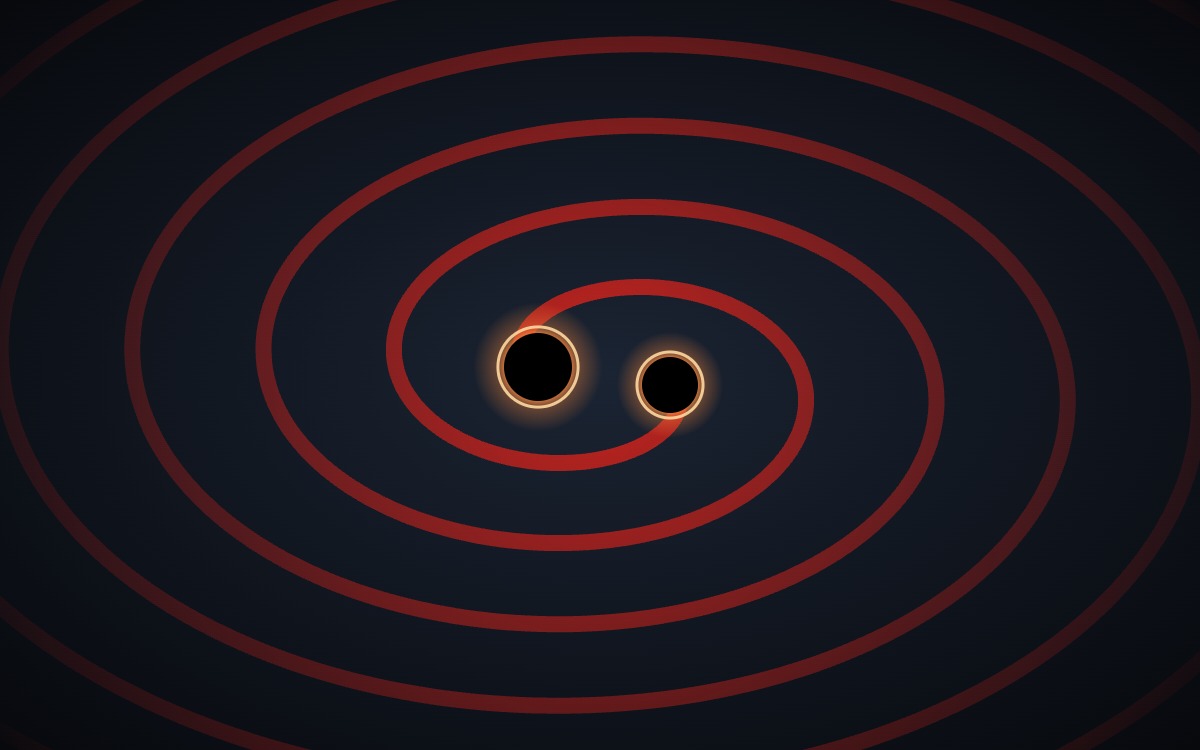 Gravity & amplitudesWhat can particle collisions teach us about colliding black holes?
 Quantum gravity & holographyWhat is spacetime made of?
 SymmetryWhat is a symmetry, and what does it forbid?
 Quantum matterHow do spins, electrons and topology create new states of matter?
 Planets, stars & black holesHow does gravity's many-body dance shape the cosmos?
 Extreme plasmasHow do cosmic plasmas make magnetic fields and cosmic rays?
 Living matterHow do living systems sense, learn and adapt?