

Our Research / Extreme plasmas
Black holes launch jets of plasma that travel at nearly the speed of light, glow across the spectrum and may hurl single protons to energies around 1020 electron-volts. Paulo Alves follows these jets down to the scale of individual electrons, using supercomputer simulations that push billions of charged particles, and finds that the jets' own motion can build magnetic fields where none existed and twist them into natural particle accelerators. He then uses machine learning to distill those huge simulations back into equations simple enough to use on the scale of a galaxy.
A universe made of plasma
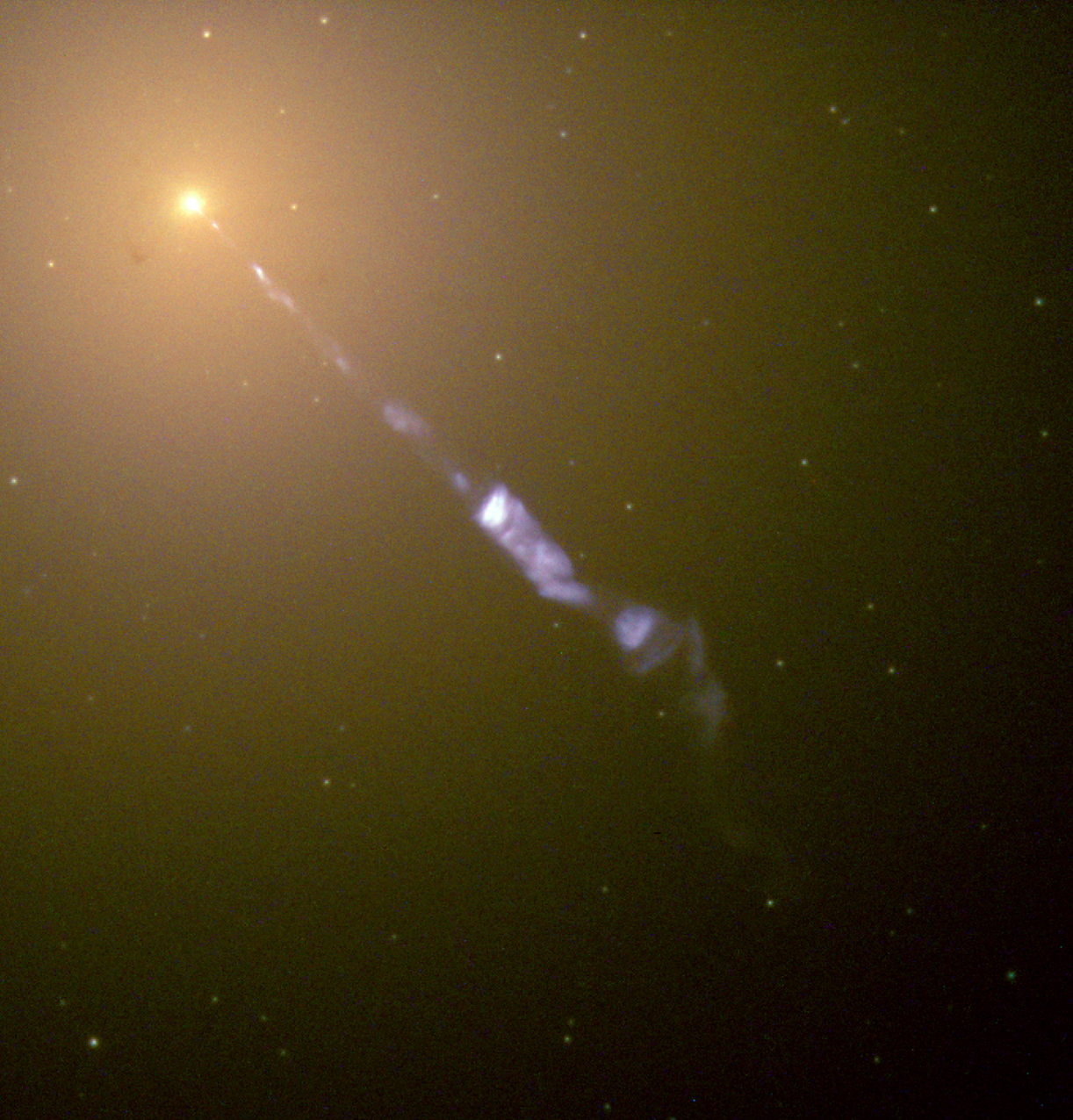
Most of the visible matter in the universe is plasma: gas so hot that electrons are torn off their atoms, leaving a soup of charged particles that both creates and responds to electric and magnetic fields. The most dramatic examples are jets from active galaxies and gamma-ray bursts, outflows powered by black holes and moving at close to the speed of light. Two puzzles hang over them. Where do their strong magnetic fields come from, if the plasma started out with little or none? And how do they turn their energy into a small population of extremely energetic particles, the kind astronomers see glowing in jets and suspect may arrive at Earth as cosmic rays?
Astrophysicists usually describe plasmas as a conducting fluid (magnetohydrodynamics, or MHD). That works well on large scales, but it averages away what individual electrons and ions do. Alves's tool of choice is the particle-in-cell (PIC) simulation, which follows enormous numbers of charged particles as they move through the fields they themselves generate. Much of this work uses OSIRIS, a massively parallel PIC code; UCLA's PICKSC center, which Alves co-leads, develops and distributes OSIRIS and related codes.
Magnetic fields from friction between flows
Where a fast jet slides past slower surroundings, the boundary is a "shear layer", like wind blowing over water. In ordinary fluids this drives the Kelvin-Helmholtz instability, which curls the boundary into rolling waves. As a PhD student in Lisbon, Alves and colleagues ran the first self-consistent 3D PIC simulations of this instability at the electron scale, in relativistic flows with no initial magnetic field (2011). The shear layer spontaneously built a strong, steady magnetic field along the entire boundary, lasting far longer than the electrons' natural timescale. Fluid models cannot capture it, because it comes from the motion of individual particles.
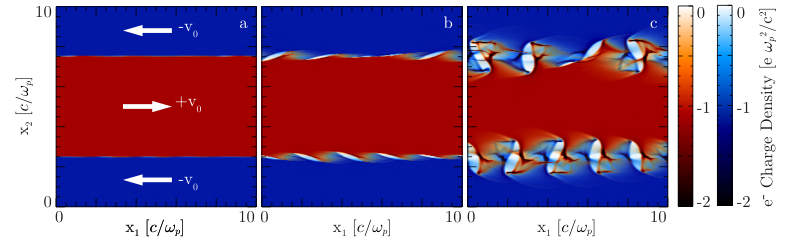
Follow-up work traced the origin: electrons from one flow spill across the shear layer while the heavier ions stay put, setting up sheets of electric current that sustain the field. Most of the instability's electromagnetic energy ends up in this steady component, and the same self-made fields can scatter and accelerate electrons (2012 to 2014). These fields could give shear layers a distinctive radiation signature, and could act as seeds that larger-scale turbulence later amplifies.
Twisted jets as cosmic particle accelerators
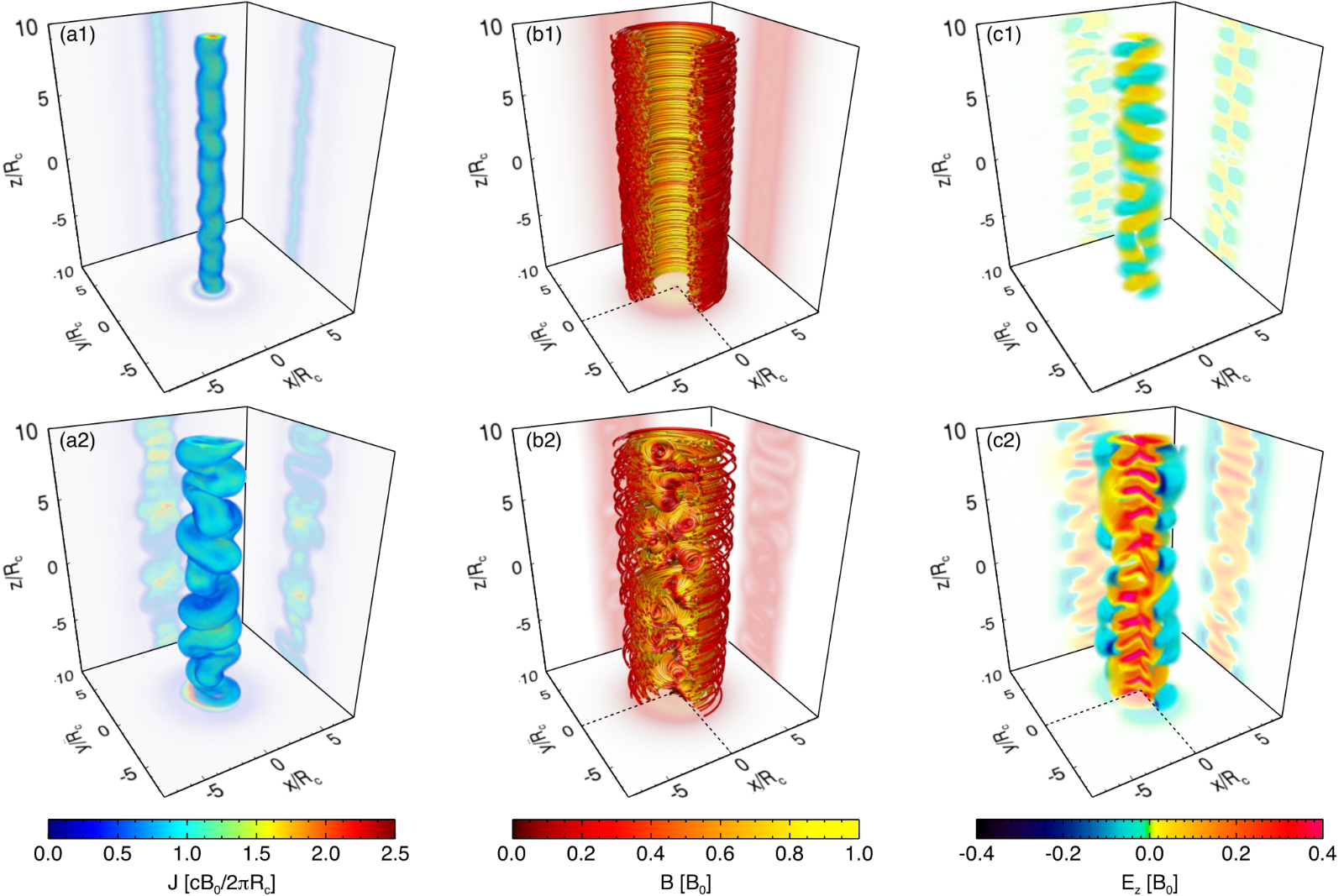
Jets are also wrapped in magnetic fields that coil around them like a spring. If the coil is wound too tightly, the jet becomes unstable to the "kink" instability and starts to wriggle and corkscrew, a behavior long familiar from fusion devices. Working at SLAC with Jonathan Zrake and Frederico Fiuza, Alves ran large 3D kinetic simulations of a kinking relativistic jet (2018, shown at the top of this page). As the jet kinked, its magnetic field became tangled and a large-scale electric field appeared along the jet axis. Together these accelerate particles rapidly and efficiently, producing the power-law energy spectra that are a hallmark of cosmic accelerators.
Applied to the bright "knots" seen in jets of active galaxies, the mechanism could account for their glow, and it may accelerate ultra-high-energy cosmic rays to about 1020 eV. A companion study of slower, non-relativistic jets found that about 10% of the initial magnetic energy goes into energetic ions, under conditions that laser-driven laboratory experiments could reproduce (2019).
Teaching machines to write plasma equations
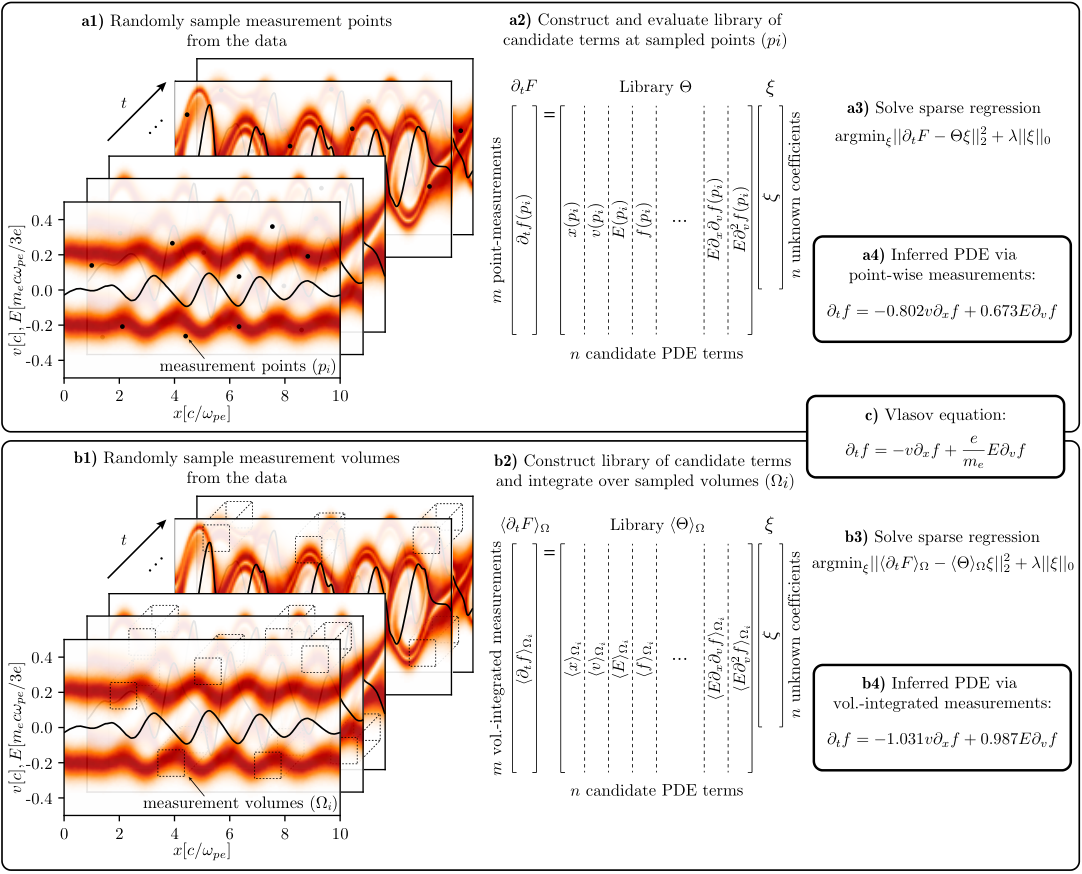
Kinetic simulations are faithful but expensive; nobody can simulate a whole galactic jet one electron at a time. The traditional fix is a reduced "fluid" model, but such models need a closure, a rule for the small-scale physics they leave out, and good closures for collisionless plasmas have been hard to derive by hand. Alves and Fiuza showed that sparse regression, a machine-learning method that picks the fewest terms from a large library of candidates, can recover the governing equations directly from simulation data, all the way from the full kinetic (Vlasov) equation down to MHD (2020). The trick was to fit integrals of the data over small volumes rather than individual points, which keeps the answer robust to the statistical noise of simulated particles.
Since moving to UCLA, Alves's group has turned this into a program. With collaborators at Chalmers they found a six-term heat-flux closure that accounts for more than 95% of the heat-flux variation in most of the electrostatic cases tested (2024), then extended it to plasmas with several particle species (2025). Another study builds known symmetries of physics into the learned models by augmenting the training data, which makes them more accurate and data-efficient (2025).
Why it matters
The same questions, how plasmas make magnetic fields and how they accelerate particles, arise in black-hole jets, in Earth's magnetosphere and in laser and fusion experiments on the ground. Alves's approach links them: first-principles simulations reveal the mechanism, and data-driven methods turn it into compact equations that larger-scale models, and eventually observers, can use.
Key papers
- Large-scale magnetic field generation via the kinetic Kelvin-Helmholtz instability in unmagnetized scenariosE. P. Alves, T. Grismayer, S. F. Martins, F. Fiúza, R. A. Fonseca, L. O. Silva · (2011). arXiv:1107.6037
- DC magnetic field generation in unmagnetized shear flowsT. Grismayer, E. P. Alves, R. Fonseca, L. O. Silva · (2012). arXiv:1205.2293
- Electron-scale shear instabilities: magnetic field generation and particle acceleration in astrophysical jetsE. P. Alves, T. Grismayer, R. A. Fonseca, L. O. Silva · (2014). arXiv:1404.0555
- Efficient nonthermal particle acceleration by the kink instability in relativistic jetsE. P. Alves, J. Zrake, F. Fiuza · (2018). arXiv:1810.05154
- Nonthermal ion acceleration by the kink instability in nonrelativistic jetsE. P. Alves, J. Zrake, F. Fiuza · (2019). arXiv:1907.11693
- Data-driven discovery of reduced plasma physics models from fully-kinetic simulationsE. P. Alves, F. Fiuza · (2020). arXiv:2011.01927
- Data-driven discovery of a heat flux closure for electrostatic plasma phenomenaE. R. Ingelsten, M. C. McGrae-Menge, E. P. Alves, I. Pusztai · (2024). arXiv:2411.18358
- Embedding physical symmetries into machine-learned reduced plasma physics models via data augmentationM. C. McGrae-Menge, J. R. Pierce, F. Fiuza, E. P. Alves · (2025). arXiv:2506.14048
Watch
More questions we are asking
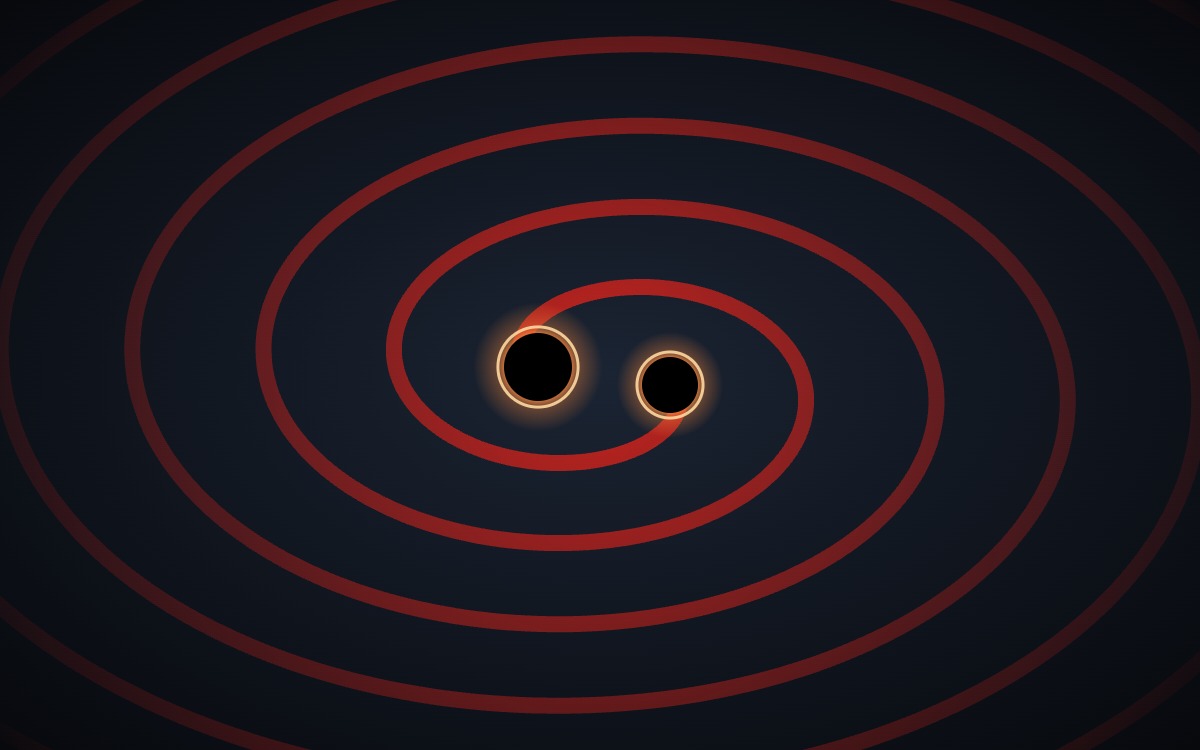 Gravity & amplitudesWhat can particle collisions teach us about colliding black holes?
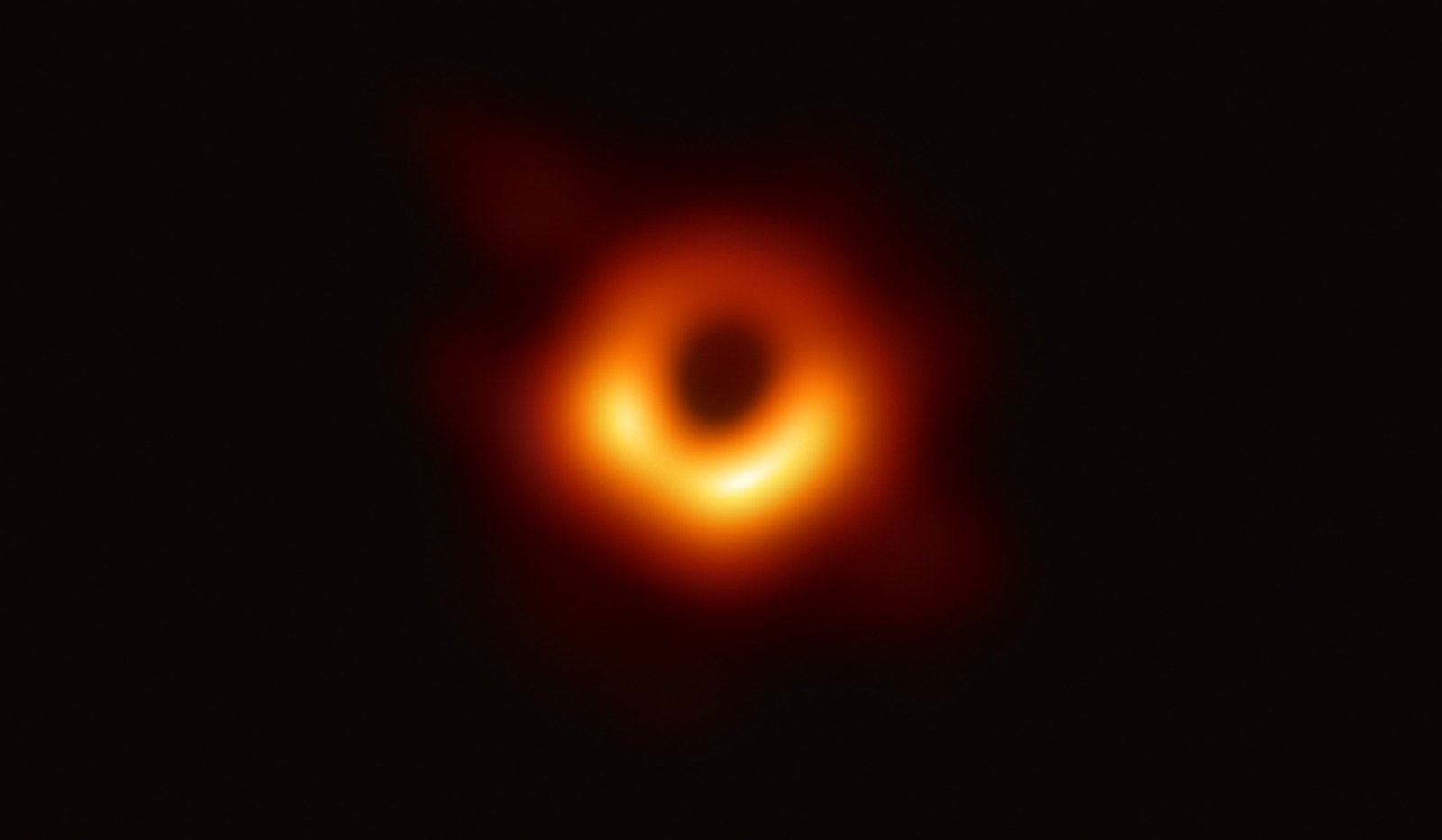 Quantum gravity & holographyWhat is spacetime made of?
 SymmetryWhat is a symmetry, and what does it forbid?
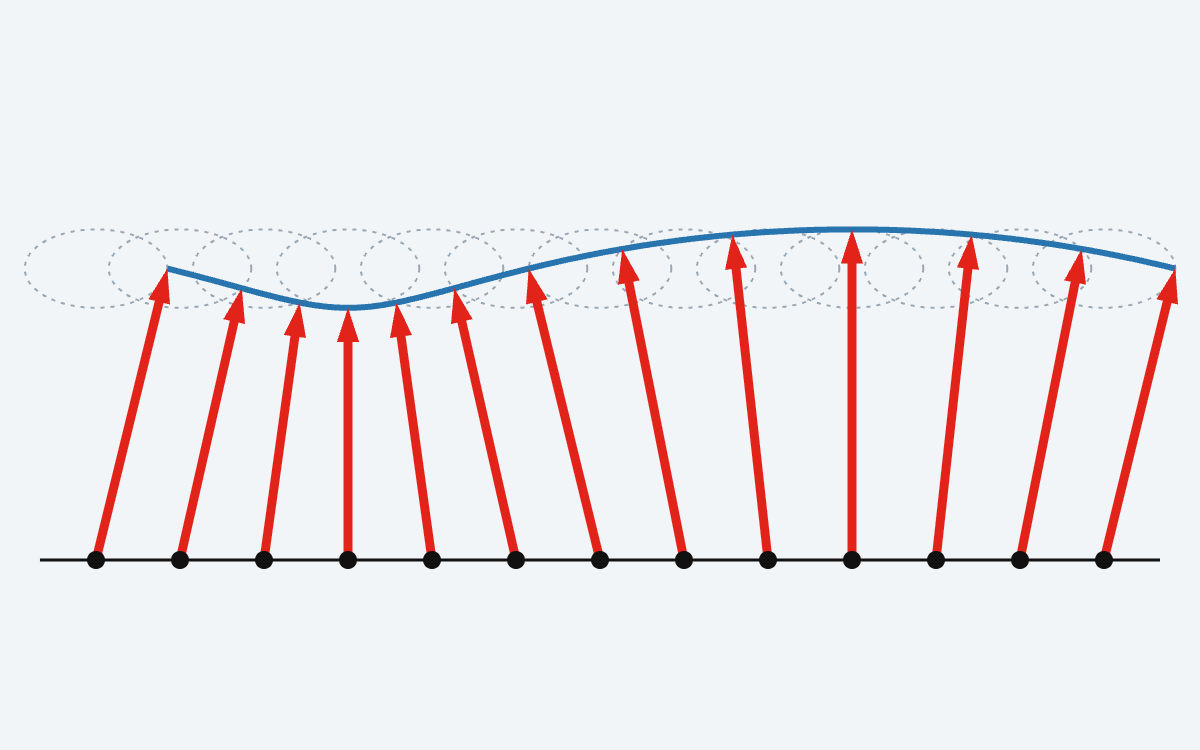 Quantum matterHow do spins, electrons and topology create new states of matter?
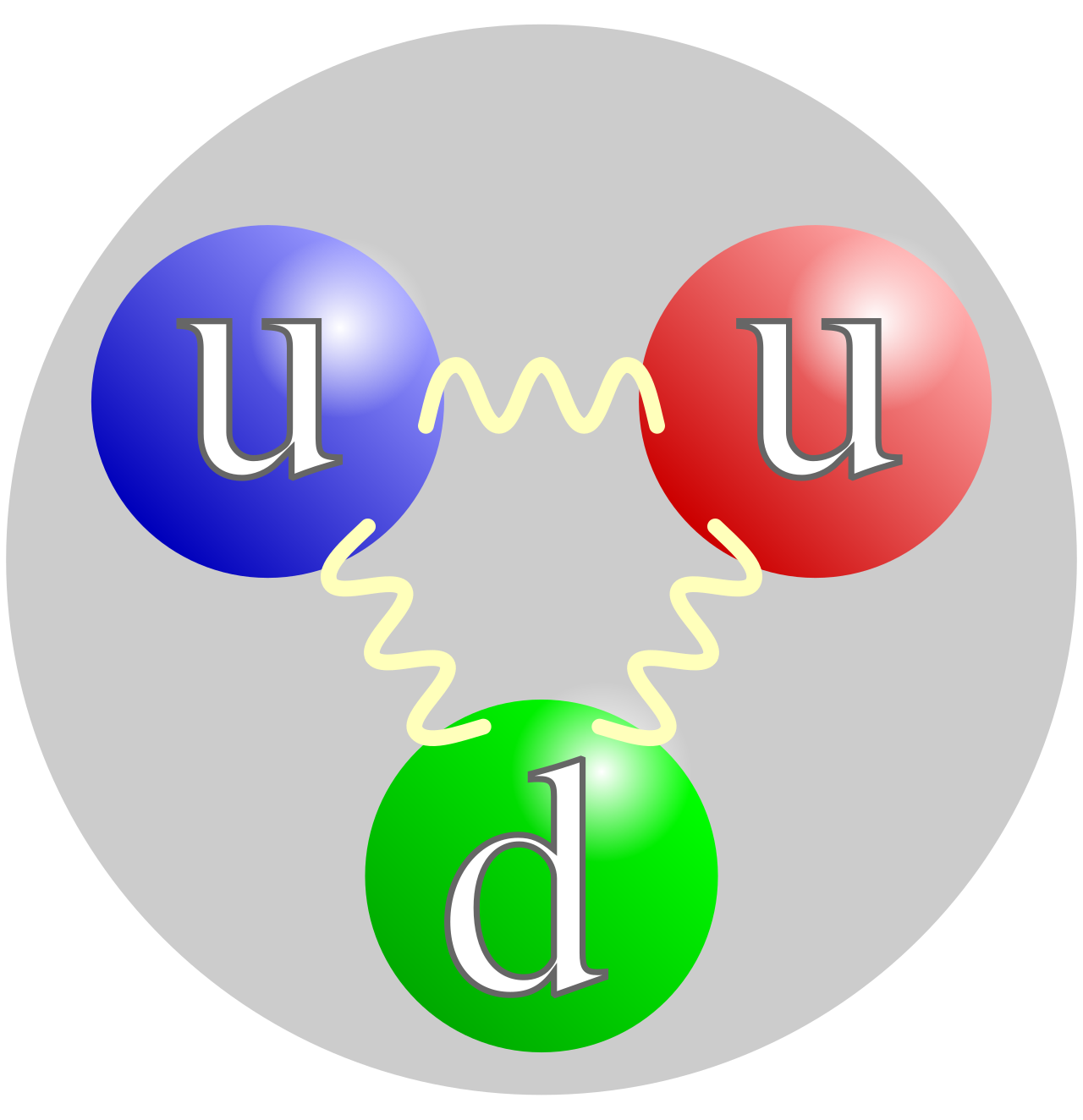 Inside the protonHow do quarks and gluons build the proton?
 Planets, stars & black holesHow does gravity's many-body dance shape the cosmos?
 Living matterHow do living systems sense, learn and adapt?